Event submissions
Published
This submission belongs to the session S2. Sustainable Fisheries and Aquaculture Innovations: Combating Overfishing and Advancing Aquatic Health of the event The 1st International Online Conference on Fishes
Published date
03 Nov, 2026
Academic Editor
 Maria Angeles Esteban
Citation
Marcio da Silva Gomes, F. F. BORGES, Michelle Roberta Dos Santos, A. L. ROCHA, H. P. BARROS, M. V. V. BOOCK, Laurindo Rodrigues, MICHELLE PINHEIRO VETORELLI, Patricia Maria Contente Moraes-Valenti, Wagner C. Valenti, Carbon dioxide and methane fluxes in ponds of Nile tilapia (Oreochromis niloticus) and integrated multi-trophic culture, in Proceedings of The 1st International Online Conference on Fishes, 5 November–6 November 2026, MDPI: Basel, Switzerland
Share
Email
Facebook
Twitter
LinkedIn
Carbon dioxide and methane fluxes in ponds of Nile tilapia (Oreochromis niloticus) and integrated multi-trophic culture

Marcio da Silva Gomes 1
F. F. BORGES 2
Michelle Roberta Dos Santos 3
A. L. ROCHA 4
H. P. BARROS 4
M. V. V. BOOCK 2
Laurindo Rodrigues 4

MICHELLE PINHEIRO VETORELLI 5
Patricia Maria Contente Moraes-Valenti 3

Wagner C. Valenti 1
1. Centro de Aquicultura da UNESP, Universidade Estadual Paulista “Júlio de Mesquita Filho” (UNESP), Jaboticabal, 14884-900, Brazil
2. Faculdade de Tecnologia Nilo De Stéfani, Fatec, Jaboticabal, Brazil
3. Aquaculture Center, São Paulo State University (UNESP), Jaboticabal 14884-900, SP, Brazil
4. Instituto de Pesca (IP), Agência Paulista de Tecnologia dos Agronegócios (APTA), Secretaria de Agricultura e Abastecimento do Estado de São Paulo, São Paulo, 04014-900, Brazil
5. Centro de Pesquisa em Agricultura do Oeste, Embrapa, Dourados, Brazil
Abstract
INTRODUCTION
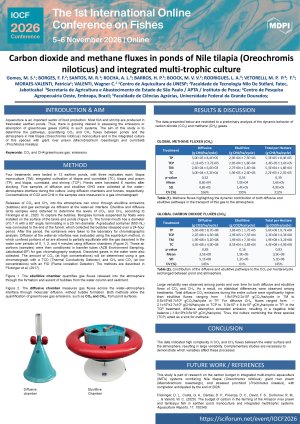
Aquaculture is an important sector of food production. Most fish and shrimp are produced in freshwater earthen ponds. Thus, there is growing interest in assessing the emissions or absorption of greenhouse gases (GHG) in such systems. The aim of this study is to determine the pathways, quantifying CO₂ and CH₄ fluxes between ponds and the atmosphere in Nile tilapia (Oreochromis niloticus) monoculture and in the integrated culture of this species with giant river prawn (Macrobrachium rosenbergii) and curimbatá (Prochilodus lineatus).
METHOD/ RESULTS
Four treatments were tested in 12 earthen ponds, with three replicates each: tilapia monoculture (TM); integrated cultivation of tilapia and curimbatá (TC); tilapia and prawn (TP); and tilapia, curimbatá, and shrimp (TCP). Ponds were harvested 6 months after stocking. Five samples of diffusive and ebullitive GHG were collected at the water–atmosphere interface during the culture, using diffusion chambers and funnels, respectively. Concentrations of CO2 and CH4 in the samples were measured in a gas chromatograph.
Large variability was observed among ponds and over time for both diffusive and ebullitive flows of CO₂ and CH₄. As a result, no statistical differences were observed among treatments. Total diffusive CO₂ emissions during the entire culture were significantly higher than ebullitive fluxes, ranging from 1.9x10⁸±3.2x10⁸ gCO₂/ha/cycle in TM to 5.6x10⁸±8.7x10⁸ gCO₂/ha/cycle in TP. For diffusive CH₄, fluxes ranged from 2.1x10⁵±3.7x10⁵ gCH4/ha/cycle in TCP to 5.0x10⁵ ± 8.4x10⁵ gCH4/ha/cycle in TP. In the TCP treatment, diffusive absorption exceeded emissions, resulting in a negative total balance (-1.8x10⁵±3.6x10⁵ gCH4/ha/cycle). Thus, the culture combining the three species (TCP) acted as a sink for methane.
CONCLUSION
The data indicated high complexity in CO₂ and CH₄ fluxes between the water surface and the atmosphere, resulting in large variability. Complementary studies are necessary to demonstrate which variables affect these processes.
Keywords
CO₂ and CH4
greenhouse gas
emissions
Poster
IOCF2026 REV FINAL.pdf
Population Dynamics and Biological Characteristics of Marcusenius senegalensis in Esa-Odo Reservoir, Southwestern Nigeria
Multiple coastal habitats structure taxonomic and functional diversity of fish assemblages in tropical estuaries with contrasting salinity regimes