Event submissions
Published
This submission belongs to the session S2. Sustainable Fisheries and Aquaculture Innovations: Combating Overfishing and Advancing Aquatic Health of the event The 1st International Online Conference on Fishes
Published date
03 Nov, 2026
Academic Editor
 Maria Angeles Esteban
Contribution&Funding
Conceptualization,
[Konrad Wojnarowski]
Methodology,
[Konrad Wojnarowski] ; [Paulina Cholewińska]
Validation,
[Konrad Wojnarowski]
Formal analysis,
[Konrad Wojnarowski] ; [Paulina Cholewińska]
Investigation,
[Konrad Wojnarowski]
Visualization,
[Paulina Cholewińska]
Supervision,
[Dušan Palić]
Funding acquisition,
[Dušan Palić]
Funding: --
Citation
Konrad Wojnarowski, Paulina Cholewińska, Dušan Palić, Host-response transcriptomics as a diagnostic guide during inconsistent pathogen detection in a haemorrhagic disease outbreak in farmed Alsatian char, in Proceedings of The 1st International Online Conference on Fishes, 5 November–6 November 2026, MDPI: Basel, Switzerland
Share
Email
Facebook
Twitter
LinkedIn
Host-response transcriptomics as a diagnostic guide during inconsistent pathogen detection in a haemorrhagic disease outbreak in farmed Alsatian char

Konrad Wojnarowski 1

Paulina Cholewińska 1

Dušan Palić 1
1. Fish Diseases and Fisheries Biology, Ludwig-Maximilians-University Munich, Munich, 80539, Germany
Abstract
Repeated pathogen-specific testing may lead to the premature exclusion of a viral aetiology when pathogen abundance is low or detection is restricted to a narrow diagnostic window. This represents a particular challenge in field investigations, where clinical signs and gross pathological findings are often non-specific and compatible with multiple infectious and non-infectious conditions.
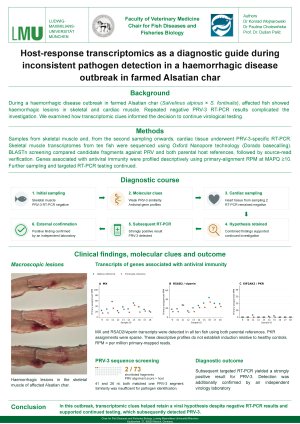
During a haemorrhagic disease outbreak in farmed Alsatian char, repeated pathogen-specific RT-PCR testing failed to detect the suspected viral agent despite sampling shortly after the reported onset of clinical signs. Affected fish showed haemorrhagic lesions involving skeletal and cardiac muscle tissues. Based on conventional diagnostic testing alone, these findings could have redirected the investigation towards alternative infectious, metabolic or environmental causes.
Transcriptomic analysis of cardiac tissue, however, revealed a pronounced host-response pattern consistent with antiviral immune activation. Additional sequence-level evidence within the transcriptomic dataset further supported continued investigation of a viral aetiology. Although these findings were not considered sufficient for definitive pathogen identification, they provided an independent molecular rationale for maintaining the original diagnostic hypothesis.
Targeted virological investigation was therefore continued, and subsequent sampling confirmed the presence of the suspected viral pathogen, with the result independently verified by an external virology laboratory.
This case demonstrates the potential value of host-response transcriptomics as a complementary diagnostic tool when direct pathogen detection is inconsistent. Rather than replacing pathogen-specific assays, transcriptomic information can provide critical diagnostic direction and help prioritize further investigation in complex disease outbreaks.
Keywords
Aquatic animal health; Host-response transcriptomics; Viral diagnostics
Poster
PRV-3 conference poster — Alsatian char.pdf
Shades of Plasticity: Tank Color Modulates Somatolactin Cells and Pigmentary Phenotypes in Tropical Gar (Atractosteus tropicus) Larvae
Cytotoxic and Apoptotic Responses to Single and Mixture PAH Exposure in Brown Trout Primary Hepatocytes