Event submissions
Published
This submission belongs to the session S1. Climate Change Impact and Marine Pollution of the event The 1st International Online Conference on Fishes
Published date
03 Nov, 2026
Academic Editor
 Pedro Morais
Contribution&Funding
Conceptualization,
[Tânia Vieira Madureira] ; [Eduardo Rocha] ; [Maria João Rocha]
Methodology,
[Rodrigo Franco Alves] ; [Tânia Vieira Madureira] ; [Célia Lopes] ; [Eduardo Rocha] ; [Maria João Rocha]
Validation,
[Tânia Vieira Madureira] ; [Célia Lopes] ; [Eduardo Rocha] ; [Maria João Rocha]
Formal analysis,
[Rodrigo Franco Alves] ; [Eduardo Rocha]
Investigation,
[Maria João Rocha] ; [Rodrigo Franco Alves] ; [Tânia Vieira Madureira] ; [Eduardo Rocha] ; [Célia Lopes] ; [Rosária Seabra]
Resources,
[Eduardo Rocha]
Data curation,
[Rodrigo Franco Alves]
Writing - original draft,
[Tânia Vieira Madureira] ; [Rodrigo Franco Alves]
Writing - review,
[editing] ; [Célia Lopes] ; [Rodrigo Franco Alves] ; [Eduardo Rocha] ; [Rosária Seabra] ; [Tânia Vieira Madureira] ; [Maria João Rocha]
Visualization,
[Tânia Vieira Madureira] ; [Eduardo Rocha]
Supervision,
[Eduardo Rocha] ; [Maria João Rocha] ; [Tânia Vieira Madureira]
Project administration,
[Eduardo Rocha]
Funding acquisition,
[Eduardo Rocha]
Funding: ATLANTIDA II (NORTE2030-FEDER-01799200) and FCT (UID/04423/2025, UID/PRR/04423/2025, LA/P/0101/2020, 2023.03276.BD - DOI identifier https://doi.org/10.54499/2023.03276.BD).
Citation
Rodrigo Franco Alves, Célia Lopes, Rosária Seabra, Maria João Rocha, Eduardo Rocha, Tânia Vieira Madureira, Cytotoxic and Apoptotic Responses to Single and Mixture PAH Exposure in Brown Trout Primary Hepatocytes, in Proceedings of The 1st International Online Conference on Fishes, 5 November–6 November 2026, MDPI: Basel, Switzerland
Share
Email
Facebook
Twitter
LinkedIn
Cytotoxic and Apoptotic Responses to Single and Mixture PAH Exposure in Brown Trout Primary Hepatocytes

Rodrigo Franco Alves 1,2
Célia Lopes 1,2
Rosária Seabra 1,2

Maria João Rocha 1,2

Eduardo Rocha 1,2

Tânia Vieira Madureira 1,2
1. Laboratory of Histology and Embryology, Department of Microscopy, School of Medicine and Biomedical Sciences (ICBAS), University of Porto, Porto, 4050-313, Portugal
2. Group of Animal Morphology and Toxicology, CIIMAR/CIMAR—Interdisciplinary Centre for Marine and Environmental Research, University of Porto, Matosinhos, 4450-208, Portugal
Abstract
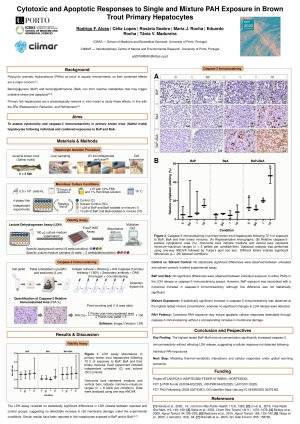
Polycyclic aromatic hydrocarbons (PAHs) are widespread environmental contaminants that pose a significant threat to aquatic ecosystems due to their persistence, bioaccumulation, and toxicity, occurring in the aquatic environments as both individual compounds and complex mixtures. Understanding the cellular effects of single and mixture PAH exposures has therefore become increasingly important to assess their ecological risk. Benzo[a]pyrene (BaP) and benzo[a]anthracene (BaA) are common priority pollutants that can be metabolically activated into reactive intermediates, leading to oxidative stress, cellular damage, and apoptosis. Primary fish hepatocytes represent a physiologically relevant in vitro model for investigating these effects while supporting the 3Rs principles (Replacement, Reduction, and Refinement).
The present study aimed to evaluate the cytotoxic and apoptotic effects of BaP and BaA, and their equimolar mixtures in primary hepatocytes isolated from brown trout (Salmo trutta). Hepatocytes were cultured at 18 °C and exposed for 72 h to control medium (supplemented Leibovitz's L-15 medium), solvent control (0.1% dimethyl sulfoxide in supplemented L-15 medium), or BaP and BaA individually or in equimolar mixtures at 1 and 10 µM. Cytotoxicity was assessed by lactate dehydrogenase (LDH) release, and apoptosis was evaluated by caspase-3 immunocytochemistry. Caspase-3 protein expression was quantified based on the intensity of cytoplasmic immunoreactivity relative to background area.
No significant differences in cytotoxicity were observed between exposure conditions. Exposure to the individual compounds did not significantly affect caspase-3 protein expression, whereas exposure to the higher mixture concentration caused a significant increase. These findings highlight the importance of considering the toxicity of PAH mixtures in aquatic organisms and suggest that mixture exposure of BaP and BaA may enhance apoptotic responses in brown trout hepatocytes.
Keywords
primary hepatocytes; Salmo trutta; polycyclic aromatic hydrocarbons; caspase-3.
Poster
Poster Fishes_ 2026_Rodrigo Alves.pdf
Host-response transcriptomics as a diagnostic guide during inconsistent pathogen detection in a haemorrhagic disease outbreak in farmed Alsatian char
Transcriptomic Responses and Antimicrobial Resistance Gene Profiles of Outbreak-Associated Aeromonas salmonicida subsp. salmonicida Isolates from Salmonid Fish