Event submissions
Published
This submission belongs to the session S2. Sustainable Fisheries and Aquaculture Innovations: Combating Overfishing and Advancing Aquatic Health of the event The 1st International Online Conference on Fishes
Published date
03 Nov, 2026
Academic Editor
 Maria Angeles Esteban
Contribution&Funding
Conceptualization,
[Noman Waheed]
Methodology,
[Noman Waheed]
Software,
[Subrat Kumar Swain] ; [Na Jiang] ; [Adeeba Naseer ]
Validation,
[Yukun Zhang] ; [Manabu Ishikawa] ; [Adeeba Naseer ]
Formal analysis,
[Adeeba Naseer ] ; [Na Jiang] ; [Subrat Kumar Swain] ; [Yukun Zhang]
Investigation,
[Noman Waheed]
Resources,
[Manabu Ishikawa] ; [Yukun Zhang]
Data curation,
[Adeeba Naseer ] ; [Na Jiang] ; [Yukun Zhang]
Writing - original draft,
[Noman Waheed]
Writing - review,
[editing] ; [Yukun Zhang] ; [Na Jiang] ; [Subrat Kumar Swain] ; [Manabu Ishikawa] ; [Adeeba Naseer ]
Visualization,
[Adeeba Naseer ] ; [Noman Waheed]
Supervision,
[Manabu Ishikawa]
Project administration,
[Noman Waheed]
Funding acquisition,
[Manabu Ishikawa]
Funding: Not applicable yet.
Citation
Noman Waheed, Adeeba Naseer , Manabu Ishikawa, Subrat Kumar Swain, Yukun Zhang, Na Jiang, Mechanistic Insights into Probiotic Integration in Recirculating Aquaculture Systems: Global Research Trends, Current Challenges and Future Perspectives, in Proceedings of The 1st International Online Conference on Fishes, 5 November–6 November 2026, MDPI: Basel, Switzerland
Share
Email
Facebook
Twitter
LinkedIn
Mechanistic Insights into Probiotic Integration in Recirculating Aquaculture Systems: Global Research Trends, Current Challenges and Future Perspectives

Noman Waheed 1,2
Adeeba Naseer 3
Manabu Ishikawa 1
Subrat Kumar Swain 4
Yukun Zhang 5,6
Na Jiang 7
1. The United Graduate School of Agricultural Science, Kagoshima University, Kagoshima, 890-0056, Japan
2. Faculty of Fisheries, Kagoshima University, Kagoshima, 890-0056, Japan
3. Graduate School of Agriculture, University of Miyazaki, Miyazaki, 889‑2192, Japan
4. Graduate School of Agriculture, Forestry and Fisheries, Kagoshima University, Kagoshima , 890-0056, Japan
5. Laboratory of Aquatic Animal Nutrition, Faculty of Fisheries, Kagoshima University, Kagoshima, 890-0056, Japan
6. Hunan Provincial Key Laboratory of the Traditional Chinese Medicine Agricultural Biogenomics, Changsha Medical University, Changsha, 410219, China
7. Fisheries Science Institute, Beijing Academy of Agriculture and Forestry Sciences, Beijing, 100068, China
Abstract
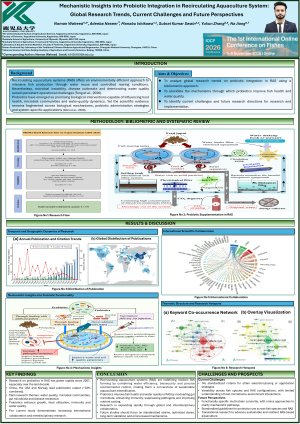
Recirculating aquaculture systems (RAS) have emerged as a sustainable aquaculture technology because of their high water-use efficiency, enhanced biosecurity, and reduced environmental impact. However, disease outbreaks, microbial instability, and deterioration of water quality remain major constraints affecting fish health and productivity. Probiotics have been found to improve growth performance, feed utilization, host immune response, and disease resistance. However, the underlying mechanisms, research evolution, collaboration patterns, and emerging research hotspots related to probiotic integration in RAS are not yet fully understood. This study provides a comprehensive analysis by integrating bibliometric analysis with a systematic review to evaluate the mechanisms through which probiotics improve fish health and water quality in RAS. Based on the selected keywords (“probiotics” OR “microbial community” OR “gut microbiota”) AND (“recirculating aquaculture system” OR “RAS” OR “water recirculation system”) AND (“fish” OR “aquaculture”), a PRISMA-guided systematic search of the Scopus database identified 376 studies published from 2001-2025. Following the extraction of metadata, the Bibliometrix app of R software (v.4.5.2) and VOSviewer (v. 1.6.20) were used to analyze publication trends, country collaboration, co-authorship networks, and keyword co-occurrence. Results revealed a rapid increase in publications after 2007, with China emerging as the leading contributor and the keyword mapping identified water quality, microbial communities, gut microbiota, and disease resistance as the major research hotspots. Mechanistic evidence demonstrated that probiotics enhance fish health by modulating gut microbiota, improving immune response, suppressing pathogenic microorganisms, and promoting nutrient cycling and biofilter performance within RAS. The findings indicate that future research is required to optimize probiotic strain selection, dosage, long-term stability, and standardized application strategies for farmed fish species in RAS. Overall, this study provides a comprehensive understanding of probiotic-mediated mechanisms in RAS, identifies current research gaps, and outlines future research perspectives to facilitate the development of more sustainable and resilient RAS-based aquaculture systems.
Keywords
Probiotics; Recirculating aquaculture systems; Microbial communities; Water quality; Gut microbiota; Immune modulation; Bibliometric analysis.
Poster
POSTER RAS.Final.pdf
Transcriptomic Responses and Antimicrobial Resistance Gene Profiles of Outbreak-Associated Aeromonas salmonicida subsp. salmonicida Isolates from Salmonid Fish
Climate-driven ocean circulation shapes larval migration success and habitat connectivity in the European eel