Event submissions
Published
This submission belongs to the session S5. Biodiversity Protection: Conservation of Endangered Species and Control of Invasive Species of the event The 1st International Online Conference on Fishes
Published date
03 Nov, 2026
Academic Editor
 Maria Angeles Esteban
Contribution&Funding
Conceptualization,
[Alexandre Ninhaus Silveira]
Validation,
[Alexandre Ninhaus Silveira]
Investigation,
[Kayode Timothy Ogundeji]
Resources,
[Alexandre Ninhaus Silveira]
Data curation,
[Kayode Timothy Ogundeji]
Writing - original draft,
[Kayode Timothy Ogundeji]
Writing - review,
[editing] ; [Alexandre Ninhaus Silveira]
Visualization,
[Alexandre Ninhaus Silveira]
Supervision,
[Alexandre Ninhaus Silveira]
Project administration,
[Kayode Timothy Ogundeji]
Funding acquisition,
[Alexandre Ninhaus Silveira]
Funding: CAPES (Coordenação de Aperfeiçoamento de Pessoal de Nível Superior)
Citation
Kayode Timothy Ogundeji, Alexandre Ninhaus Silveira, Carmen Manjate, Lorena Pacheco da Silva, Rodrigo Yutaka Dichoff Kasai, Rosicleire Veríssimo Silveira, SEMINAL CHARACTERIZATION AND CRYOPRESERVATION OF SEMEN FROM AMAZONA JUNDIA, Leiarius marmoratus., in Proceedings of The 1st International Online Conference on Fishes, 5 November–6 November 2026, MDPI: Basel, Switzerland
Share
Email
Facebook
Twitter
LinkedIn
SEMINAL CHARACTERIZATION AND CRYOPRESERVATION OF SEMEN FROM AMAZONA JUNDIA, Leiarius marmoratus.

Kayode Timothy Ogundeji 1
Alexandre Ninhaus Silveira 1
Carmen Manjate 1
Lorena Pacheco da Silva 1
Rodrigo Yutaka Dichoff Kasai 1
Rosicleire Veríssimo Silveira 1
1. LINEO – Laboratory of Neotropical Ichthyology, Department of Biology and Animal Science, UNESP/FEIS - São Paulo State University “Júlio de Mesquita Filho” - Ilha Solteira Campus, Ilha Solteira, 15385000, Brazil
Abstract
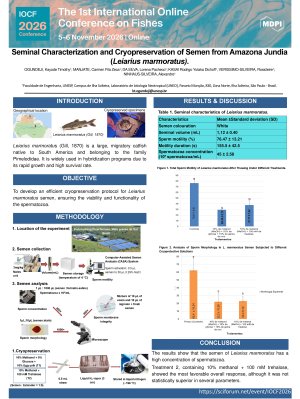
Developing an effective sperm cryopreservation protocol is important for the conservation and reproductive management of freshwater fish species with aquaculture and genetic potential. Leiarius marmoratus is a Neotropical catfish of growing interest for reproductive biotechnology. This study aimed to characterize the seminal parameters of L. marmoratus and evaluate the effects of two cryoprotectant solutions on sperm quality after cryopreservation. Semen was collected from five sexually mature males and evaluated for volume, sperm concentration, total motility, plasma membrane integrity, and sperm morphology. Sperm motility kinetics were assessed using computer-assisted sperm analysis (CASA). Fresh semen was subsequently cryopreserved using two treatments: T1, containing 10% methanol, 5% glucose, and 10% egg yolk; and T2, containing 10% methanol and 100 mM trehalose. Fresh semen exhibited a volume of 1.12 ± 0.40 mL, a sperm concentration of 45 × 10⁹ ± 2.58 spermatozoa mL⁻¹, and total motility of 76.47 ± 13.21%. Following thawing, total motility decreased significantly to 29.38 ± 1.62% and 37.77 ± 16.59% in T1 and T2, respectively, compared with fresh semen (P < 0.05). Cryopreservation also reduced several CASA-derived kinetic parameters, including straight-line velocity, average path velocity, linearity, straightness, wobble, and beat cross frequency, while curvilinear velocity was comparatively less affected. Plasma membrane integrity decreased from 91.40 ± 4.05% in fresh semen to 23.90 ± 4.52% and 19.60 ± 3.38% in T1 and T2, respectively. Similarly, normal sperm morphology declined after cryopreservation. No significant differences (P > 0.05) were observed between the two cryoprotectant treatments for total motility. Overall, cryopreservation significantly reduced sperm motility, membrane integrity, and morphology in L. marmoratus. While both treatments yielded limited post-thaw sperm quality, the results offer essential baseline data for optimizing cryopreservation protocols for this species and highlight its potential use in reproductive biotechnology and germplasm conservation.
Keywords
Leiarius marmoratus; sperm quality; cryopreservation; CASA; cryoprotectants; reproductive biotechnology.
Poster
Kayode_Poster_Fish_Repro_2026.pdf
Climate-driven ocean circulation shapes larval migration success and habitat connectivity in the European eel
Biotechnological Processing of Algal Biomass for Improved Nutrient Bioavailability and Sustainable Valorization