Event submissions
Published
This submission belongs to the session S2. Sustainable Fisheries and Aquaculture Innovations: Combating Overfishing and Advancing Aquatic Health of the event The 1st International Online Conference on Fishes
Published date
03 Nov, 2026
Academic Editor
 Maria Angeles Esteban
Contribution&Funding
Conceptualization,
[Leila Isabel Urrutia-Mazzuca] ; [Francisco Javier Alarcón López]
Formal analysis,
[Leila Isabel Urrutia-Mazzuca]
Investigation,
[Leila Isabel Urrutia-Mazzuca] ; [Alejandro Antonio Morcillo Guillén] ; [María Jiménez Berlanga]
Writing - original draft,
[Leila Isabel Urrutia-Mazzuca]
Writing - review,
[editing] ; [Leila Isabel Urrutia-Mazzuca] ; [Francisco Javier Alarcón López]
Supervision,
[Dimo Atanasov] ; [Tania Mazzuca Sobczuk] ; [Francisco Javier Alarcón López]
Funding: The author Leila Urrutia would like to thank the scholarship from the Unigreen Consortium-The Green European University
Citation
Leila Isabel Urrutia-Mazzuca, Alejandro Antonio Morcillo Guillén, María Jiménez Berlanga, Dimo Atanasov, Tania Mazzuca Sobczuk, Francisco Javier Alarcón López, Biotechnological Processing of Algal Biomass for Improved Nutrient Bioavailability and Sustainable Valorization, in Proceedings of The 1st International Online Conference on Fishes, 5 November–6 November 2026, MDPI: Basel, Switzerland
Share
Email
Facebook
Twitter
LinkedIn
Biotechnological Processing of Algal Biomass for Improved Nutrient Bioavailability and Sustainable Valorization

Leila Isabel Urrutia-Mazzuca 1,2,3
Alejandro Antonio Morcillo Guillén 3
María Jiménez Berlanga 3
Dimo Atanasov 2

Tania Mazzuca Sobczuk 4,5

Francisco Javier Alarcón López 3
1. Dipartimento di Scienze della Vita, Università degli Studi di Modena e Reggio Emilia, Unigreen Consortium, Modena, Reggio Emilia, 42122 , Italy
2. Department of Economics, Agricultural University of Plovdiv, Unigreen Consortium, Plovdiv, 4000, Bulgaria
3. Department of Biology and Geology, Higher School of Engineering, University of Almería, Almeria, 04120, Spain
4. Department of Chemical Engineering, University of Almeria, Unigreen Consortium, Almeria, 04120 , Spain
5. Centro de Investigación en Agrosistemas Intensivos Mediterráneos y Biotecnología Agroalimentaria (CIAIMBITAL) , University of Almeria, Almeria, 04120, Spain
Abstract
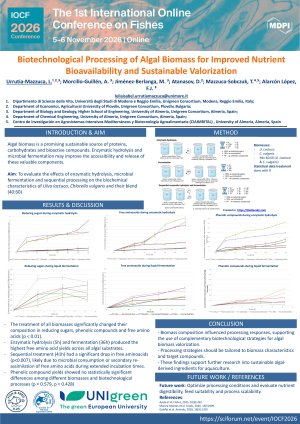
Introduction: Algal biomasses are promising sustainable feedstocks for producing high-value ingredients due to their protein, polysaccharide, and bioactive compound content. Their cultivation requires limited arable land compared to conventional crops, making them attractive alternatives for sustainable food and feed production. This study evaluated biotechnological strategies to enhance nutrient bioavailability in Ulva lactuca, Chlorella vulgaris, and a blend containing 40% U. lactuca and 60% C. vulgaris.
Methods: Each biomass had two replicas subjected to enzymatic hydrolysis (Rovabio® and Alcalase®), fermentation (Saccharomyces cerevisiae and Bacillus subtilis), and hydrolysis followed by fermentation. Process performance was assessed by measuring in three samples of each replica reducing sugars, free amino acids and total phenolic compounds as indicators of carbohydrate hydrolysis, protein degradation, and the release of bioactive compounds.
Results: All treatments promoted biochemical modifications in the algal biomasses, although the magnitude of these changes depended on biomass type and processing strategy. During enzymatic hydrolysis, all biomasses released similar amounts of soluble carbohydrates, although Ulva showed a slower release and greater differences among treatment replicas, probably due to ulvan interference. Amino acid release was similar among all biomasses, whereas the lowest release of phenolic compounds was observed in Ulva (≈13mg tannic acid equivalents/100g biomass). During fermentation, Ulva exhibited the highest release of both soluble carbohydrates (≈2g/100g biomass) and amino acids (≈6g/100g protein), while Chlorella showed the highest phenolic compound release (≈14mg tannic acid equivalents/100g biomass). Overall, the contrasting responses among the three biomasses highlight the influence of cell wall composition on treatment, demonstrating the complementary roles of enzymatic and microbial processes in biomass valorization. All results were statistically significant.
Conclusions: The combined evaluation of different algal biomasses and biotechnological treatments helps identify processing conditions that maximize nutrient bioavailability and biomass valorization. These findings support the development of sustainable algal-derived ingredients for aquaculture within a circular bioeconomy.
Keywords
algal biomass valorization
Chlorella vulgaris
circular bioeconomy
enzymatic hydrolysis
microbial fermentation
nutrient bioavailability
Ulva lactuca
Poster
Poster biotechnological processing.pdf
SEMINAL CHARACTERIZATION AND CRYOPRESERVATION OF SEMEN FROM AMAZONA JUNDIA, Leiarius marmoratus.
Valorization of Restaurant Vegetable Residues as Sources of Natural Pigments and Antioxidants for Sustainable Aquaculture Feed Development