Event submissions
Published
This submission belongs to the session S2. Sustainable Fisheries and Aquaculture Innovations: Combating Overfishing and Advancing Aquatic Health of the event The 1st International Online Conference on Fishes
Published date
03 Nov, 2026
Academic Editor
 Maria Angeles Esteban
Contribution&Funding
Conceptualization,
[Marcia Mazzuca] ; [Tania Mazzuca Sobczuk] ; [María José Ibañez González]
Investigation,
[Gabriela Pérez] ; [Juan Manuel Úbeda Tirado] ; [Juan Manuel Guerrero Cazorla] ; [Leila Isabel Urrutia-Mazzuca]
Data curation,
[Gabriela Pérez]
Writing - original draft,
[Leila Isabel Urrutia-Mazzuca]
Writing - review,
[editing] ; [Leila Isabel Urrutia-Mazzuca] ; [Gabriela Pérez] ; [Tania Mazzuca Sobczuk]
Supervision,
[Tania Mazzuca Sobczuk] ; [María José Ibañez González] ; [Marcia Mazzuca] ; [Francisco Javier Alarcón López] ; [Dimo Atanasov]
Funding: The author Leila Urrutia would like to thank the scholarship from the Unigreen Consortium-The Green European University.
Citation
Leila Isabel Urrutia-Mazzuca, Gabriela Pérez, Juan Manuel Úbeda Tirado, Juan Manuel Guerrero Cazorla, Dimo Atanasov, Francisco Javier Alarcón López, Marcia Mazzuca, María José Ibañez González, Tania Mazzuca Sobczuk, Valorization of Shrimp By-Products (Pleoticus muelleri): Influence of Blanching and Grinding on the Extraction of Carotenoids and Fatty Acids, in Proceedings of The 1st International Online Conference on Fishes, 5 November–6 November 2026, MDPI: Basel, Switzerland
Share
Email
Facebook
Twitter
LinkedIn
Valorization of Shrimp By-Products (Pleoticus muelleri): Influence of Blanching and Grinding on the Extraction of Carotenoids and Fatty Acids

Leila Isabel Urrutia-Mazzuca 1,2,3
Gabriela Pérez 4
Juan Manuel Úbeda Tirado 5
Juan Manuel Guerrero Cazorla 5
Dimo Atanasov 2

Francisco Javier Alarcón López 3

Marcia Mazzuca 4,6

María José Ibañez González 5,7

Tania Mazzuca Sobczuk 5,7
1. Dipartimento di Scienze della Vita, Università degli Studi di Modena e Reggio Emilia, Unigreen Consortium, Modena, Reggio Emilia, 42122 , Italy
2. Department of Economics, Agricultural University of Plovdiv, Unigreen Consortium, Plovdiv, 4000, Bulgaria
3. Department of Biology and Geology, Higher School of Engineering, University of Almería, Unigreen Consortium, Almeria, 04120, Spain
4. Faculty of Natural and Health Sciences, National Patagonian University San Juan Bosco, Comodoro Rivadavia, 9005, Argentina
5. Department of Chemical Engineering, University of Almeria, Almeria, 04120, Spain
6. CONICET, INBIOP (Instituto de Biociencias de la Patagonia), National Patagonian University San Juan Bosco., Comodoro Rivadavia, 9005, Argentina
7. Centro de Investigación en Agrosistemas Intensivos Mediterráneos y biotecnología Agroalimentaria (CIAIMBITAL), University of Almeria, Almeria, 04120, Spain
Abstract
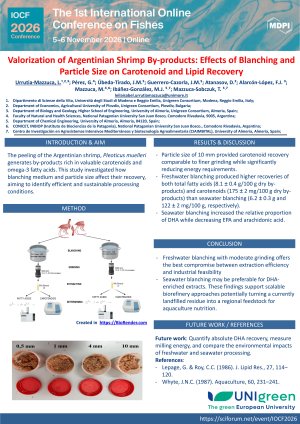
Introduction: The peeling of the Argentinian shrimp, Pleoticus muelleri, generates substantial by-products that are an underutilized source of high-value compounds such as astaxanthin and omega-3 fatty acids (EPA and DHA). This study evaluated the effects of blanching and particle-size reduction on the extraction efficiency of carotenoids and lipids, aiming to support sustainable valorization of shrimp processing residues.
Methods: Heads, shells and tails from shrimp peeling were blanched (70 °C , 3 min, 1:25 biomass/water) in freshwater or seawater. After grinding in a Retsch ZM 200 mill at 8000 rpm using 10, 3, 1 and 0.5 mm screens, lipids were extracted with 96% ethanol (25 °C, three successive extraction steps). Carotenoids were determined spectrophotometrically at 444 nm (Whyte, 1987), and fatty acids by direct transesterification (Lepage & Roy, 1984) using C19:0 as internal standard, followed by gas chromatography.
Results: Reducing particle size to 10 mm provided carotenoid recovery comparable to finer grinding while significantly reducing energy requirements, making it more suitable for industrial implementation. Freshwater blanching produced higher recoveries of both total fatty acids (8.1 ± 0.4 g/100 g dry by-products) and carotenoids (175 ± 2 mg/100 g dry by-products) than seawater blanching (6.2 ± 0.3 g and 122 ± 2 mg/100 g, respectively). Although seawater reduced overall extraction yields, it increased the relative proportion of DHA while decreasing EPA and arachidonic acid.
Conclusions: Freshwater blanching combined with moderate grinding offers the best compromise between extraction efficiency and industrial feasibility, while seawater blanching may be preferable for DHA-enriched extracts. Although seawater lowers extraction yield, it requires less potable water at a water-intensive stage, and explicit sustainability criteria are needed to guide this choice. These findings support scalable biorefinery approaches potentially turning a currently landfilled residue into a regional feedstock for aquaculture nutrition.
Keywords
Pleoticus muelleri
shrimp by-products
seafood waste valorization
astaxanthin
omega-3 fatty acids
biorefinery
circular economy.
Poster
Poster shrimp valorisation.pdf
Valorization of Restaurant Vegetable Residues as Sources of Natural Pigments and Antioxidants for Sustainable Aquaculture Feed Development
Molecular identification of fish-associated bacteria as a tool for sustainable marine aquaculture