Event submissions
Published
This submission belongs to the session S2. Sustainable Fisheries and Aquaculture Innovations: Combating Overfishing and Advancing Aquatic Health of the event The 1st International Online Conference on Fishes
Published date
03 Nov, 2026
Academic Editor
 Maria Angeles Esteban
Citation
Brigita Novosel, Molecular identification of fish-associated bacteria as a tool for sustainable marine aquaculture, in Proceedings of The 1st International Online Conference on Fishes, 5 November–6 November 2026, MDPI: Basel, Switzerland
Share
Email
Facebook
Twitter
LinkedIn
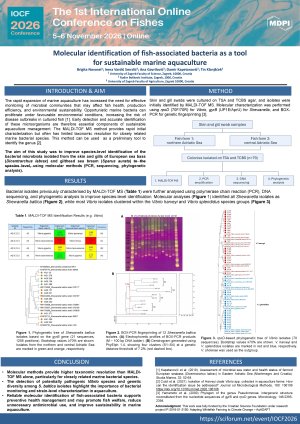
Molecular identification of fish-associated bacteria as a tool for sustainable marine aquaculture

Brigita Novosel 1
1. Faculty of Science and Mathematics, University of Zagreb, 10 000 Zagreb, Croatia
Abstract
Seawater quality is one of the most important factors affecting the success of marine aquaculture, influencing the growth, health status, and survival of cultured organisms. The aim of this study was to evaluate the influence of the physico-chemical and microbiological characteristics of seawater on the growth and survival of European sea bass (Dicentrarchus labrax) and sea bream (Sparus aurata) reared in a sea cage farming system. The study was conducted from May 2020 to July 2021. Fish growth, feed conversion ratio, condition factor, and survival were monitored throughout the study period. Seawater temperature, dissolved oxygen concentration, and oxygen saturation were measured regularly. Water samples collected at the fish farm and a control site were analysed for total heterotrophic bacterial count, Vibrio spp., Escherichia coli, and enterococci. Cages with a diameter of 22 meters were used. At stocking, 130,000 European sea bass with an average body weight of 6.2 g and 130,000 gilthead sea bream with an average body weight of 5.2 g were stocked in the cages. At the end of the study, the average body weight reached 187 g for European sea bass and 196 g for gilthead sea bream. Survival rates exceeded 85% in both species, and no disease outbreaks associated with increased mortality were recorded during the study period. Seawater temperature ranged from 10.5 to 26 °C, with the highest average monthly temperature of 24.8 °C recorded in August 2020. The mean dissolved oxygen concentration was 7.71 mg/L, while oxygen saturation ranged from 83.8 to 99.94%, with an overall mean of 91.97%. Indicators of fecal contamination (E. coli and enterococci) remained below 10 MPN/100 mL at both sampling sites. The potentially pathogenic bacterium V. harveyi was detected at both sampling sites, whereas V. alginolyticus was identified only at the fish farm. The low abundance of isolated bacteria, together with stable environmental conditions, indicates good microbiological seawater quality and favourable conditions for fish farming. The results highlight the importance of continuous seawater quality monitoring for the early detection of potential risks, maintaining the health of cultured fish, optimizing production performance, and supporting the sustainable management of marine aquaculture.
Keywords
marine aquaculture; seawater quality; European sea bass (Dicentrarchus labrax); gilthead sea bream (Sparus aurata); Vibrio; microbiology
Poster
Novosel i sur. Molecular....pdf
Valorization of Shrimp By-Products (Pleoticus muelleri): Influence of Blanching and Grinding on the Extraction of Carotenoids and Fatty Acids
Effects of Microplastics and Amoxicillin Exposure on the Innate Immune Responses of Gilthead Seabream (Sparus aurata).