Event submissions
Published
This submission belongs to the session S1. Climate Change Impact and Marine Pollution of the event The 1st International Online Conference on Fishes
Published date
03 Nov, 2026
Academic Editor
 Pedro Morais
Contribution&Funding
Writing - original draft,
[Chayma Dhibi]
Supervision,
[Alberto Cuesta]
Funding: --
Citation
Chayma Dhibi, Francisco Jose Fernández-Hernández, Tarek Hajji, Alberto Cuesta, Effects of Microplastics and Amoxicillin Exposure on the Innate Immune Responses of Gilthead Seabream (Sparus aurata)., in Proceedings of The 1st International Online Conference on Fishes, 5 November–6 November 2026, MDPI: Basel, Switzerland
Share
Email
Facebook
Twitter
LinkedIn
Effects of Microplastics and Amoxicillin Exposure on the Innate Immune Responses of Gilthead Seabream (Sparus aurata).

Chayma Dhibi 1
Francisco Jose Fernández-Hernández 2
Tarek Hajji 3
Alberto Cuesta 4
1. Faculty of Sciences, University of Tunis El Manar, Tunis, Tunisia
2. Department of Cell Biology and Histology, Faculty of Biology, University of Murcia, Murcia, Spain
3. Laboratory of Biotechnology and Bio-Geo Resource Valorization LR11ES31, Higher Institute of Biotechnology of Sidi Thabet, University of Manouba, Ariana, Tunisia
4. Faculty of Biology, University of Murcia, Murcia, 30100, Spain
Abstract
Introduction: Microplastics (MPs) and antibiotics are increasingly found in aquatic environments and may affect fish health. MPs can interact with other contaminants, potentially modifying their biological effects. Amoxicillin (AMX) is a widely used antibiotic that can also reach aquatic ecosystems. This study investigated the effects of MPs, AMX, and their combined exposure on innate immune responses in gilthead seabream (Sparus aurata).
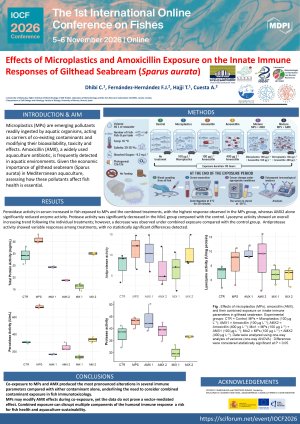
Methodology: Fish were exposed for 96 h to MPs (100 µg L⁻¹), AMX at 100 µg L⁻¹ (AMX1) or 400 µg L⁻¹ (AMX2), or combined treatments of MPs with AMX1 (Mix1) and AMX2 (Mix2). A clean-water group was used as the control. After exposure, serum innate immune parameters were evaluated by measuring lysozyme, peroxidase, protease, and antiprotease activities.
Results: Exposure to MPs and AMX significantly affected several immune parameters (P < 0.05). Peroxidase activity increased in the MP group and in both combined exposure groups, with the highest activity observed in fish exposed to MPs alone. In contrast, AMX2 significantly decreased peroxidase activity. Protease activity was significantly lower in the Mix1 group compared with the control. Lysozyme activity generally increased after individual exposure to MPs and AMX. However, combined exposure resulted in lower lysozyme activity compared with the control. Antiprotease activity showed different responses among treatments, but no significant differences were observed.
Conclusions: These results show that short-term exposure to MPs and AMX can alter several innate immune responses in gilthead seabream. The responses observed after combined exposure differed from those induced by individual treatments, indicating that the presence of both contaminants may modify immune responses. However, these results do not confirm that MPs act as vectors or carriers of AMX. Overall, this study highlights the potential effects of contaminant mixtures on fish innate immunity and the importance of considering combined exposure when assessing environmental risks in aquatic organisms.
Keywords: Sparus aurata; microplastics; amoxicillin; innate immunity; lysozyme; peroxidase.
Funding: This research was supported by grants PID2022-139492NB-I00, funded by MICIU/AEI/10.13039/501100011033 and co-funded by ERDF/EU, and 23025/GERM/25, funded by FSRM/10.13039/100007801.
Keywords
Sparus aurata; microplastics; amoxicillin; innate immunity; lysozyme; peroxidase; IgM; bactericidal activity.
Poster
Poster MPs+AMX.pdf
Molecular identification of fish-associated bacteria as a tool for sustainable marine aquaculture
Advanced Aquatic Health: Machine Learning-Based Aquatic Model Development for Sustainable Local Fish Culture