Event submissions
Published
This submission belongs to the session S2. Sustainable Fisheries and Aquaculture Innovations: Combating Overfishing and Advancing Aquatic Health of the event The 1st International Online Conference on Fishes
Published date
03 Nov, 2026
Academic Editor
 Maria Angeles Esteban
Citation
Ahnaf Ayman, Md Salah uddin, Advanced Aquatic Health: Machine Learning-Based Aquatic Model Development for Sustainable Local Fish Culture, in Proceedings of The 1st International Online Conference on Fishes, 5 November–6 November 2026, MDPI: Basel, Switzerland
Share
Email
Facebook
Twitter
LinkedIn
Advanced Aquatic Health: Machine Learning-Based Aquatic Model Development for Sustainable Local Fish Culture

Ahnaf Ayman 1
Md Salah uddin 2
1. Department of Electrical and Computer Engineering, North South University, Dhaka, 1229, Bangladesh
2. Department of Mathematics and Physics, North South University, Dhaka, 1229, Bangladesh
Abstract
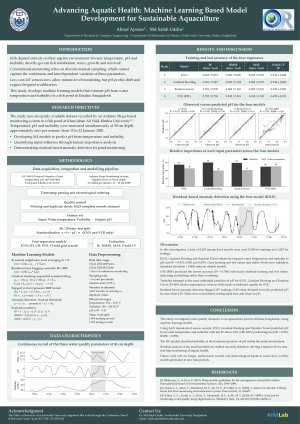
Sustainable aquaculture relies on continuous monitoring and accurate prediction of water quality parameters to ensure optimal aquatic health and maximize production. Conventional monitoring often relies on discrete sampling, which fails to develop the dynamic interdependencies among critical physicochemical parameters. This study addresses this gap by developing machine learning (ML) models using an openly available water quality dataset collected from a fish pond in Khulna, Bangladesh[1].
We investigated the relationship among three fundamental parameters by employing machine learning techniques to predict pH from water temperature and turbidity measurements. The dataset was acquired using an Arduino Mega-based monitoring system integrated with digital sensors installed at a water depth of 30 cm. Temperature, pH, and turbidity were measured simultaneously at approximately one-minute intervals over a continuous seven-day period (15–22 January 2020), generating a dataset of 9,623 measurements for model development. During the monitoring period, water temperature ranged from 15.6 to 23.8°C, turbidity ranged from 194 to 249 NTU, and pH ranged from 6.98 to 8.43. The collected dataset was preprocessed, divided into the training and testing subsets (80/20), and evaluated using the coefficient of determination (R²), mean absolute error (MAE), and root mean square error (RMSE). Model validation and feature importance analyses were also conducted to assess prediction reliability and quantify the influence of individual input variables.
We applied K-Nearest Neighbors (KNN) Regressor, Random Forest (RF), Gradient Boosting (GB), and Support Vector Regression (RBF) models to the processed datasets. We found that the ML models can effectively learn the nonlinear relationships and temporal patterns within the water quality parameters, offering a robust framework for near-real-time forecasting and anomaly detection. We evaluated ML frameworks and found strong regression performance with the GB (87%, RMSE 0.15), KNN Regressor (95%, RMSE 0.09), SVR (RBF) (69%, RMSE 0.24), and RF (97%, RMSE 0.11) models. We also found that turbidity is the most influential parameter affecting the pH in the water.
[1] Arafat, A. I.; Akter, T.; Ahammed, M. F.; Ali, M. Y.; Nahid, A. A. Data in Brief, 2020, 33, 106457.
Keywords
Water quality
Machine learning
Water temperature
Turbidity
Aquaculture
Poster
Aquahealth poster.pdf
Effects of Microplastics and Amoxicillin Exposure on the Innate Immune Responses of Gilthead Seabream (Sparus aurata).
Natural preservative biofilms based on Salicornia europaea extract and microalgae hydrolysates for European seabass fillets