Event submissions
Published
This submission belongs to the session S2. Sustainable Fisheries and Aquaculture Innovations: Combating Overfishing and Advancing Aquatic Health of the event The 1st International Online Conference on Fishes
Published date
03 Nov, 2026
Academic Editor
 Maria Angeles Esteban
Contribution&Funding
Conceptualization,
[María Isabel Sáez Casado] ; [Tomas Martínez Moya] ; [Joan Montaner]
Methodology,
[Lidia Jiaduo Padial Ruiz] ; [María Isabel Sáez Casado] ; [Tomas Martínez Moya]
Investigation,
[Lidia Jiaduo Padial Ruiz] ; [Javier Sabio Sánchez ]
Resources,
[Joan Montaner]
Data curation,
[María Isabel Sáez Casado]
Writing - original draft,
[Lidia Jiaduo Padial Ruiz]
Writing - review,
[editing] ; [María Isabel Sáez Casado]
Supervision,
[Tomas Martínez Moya] ; [Joan Montaner] ; [María Isabel Sáez Casado]
Project administration,
[Tomas Martínez Moya] ; [María Isabel Sáez Casado]
Funding: This work was carried out within the framework of the MICROALGAE4BASS project (PID2024-158025OB-C21).
Citation
Lidia Jiaduo Padial Ruiz, Javier Sabio Sánchez , Tomas Martínez Moya, Joan Montaner, María Isabel Sáez Casado, Natural preservative biofilms based on Salicornia europaea extract and microalgae hydrolysates for European seabass fillets, in Proceedings of The 1st International Online Conference on Fishes, 5 November–6 November 2026, MDPI: Basel, Switzerland
Share
Email
Facebook
Twitter
LinkedIn
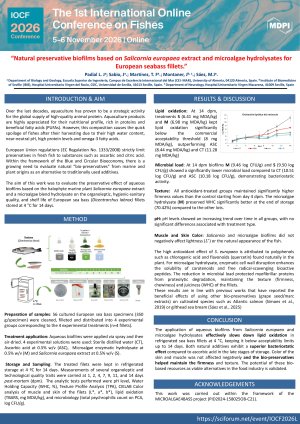
Natural preservative biofilms based on Salicornia europaea extract and microalgae hydrolysates for European seabass fillets

Lidia Jiaduo Padial Ruiz 1
Javier Sabio Sánchez 1
Tomas Martínez Moya 1
Joan Montaner 2
María Isabel Sáez Casado 1
1. Department of Biology and Geology, Escuela Superior de Ingeniería, Campus de Excelencia Internacional del Mar (CEI· MAR), University of Almeria, Almería, Spain
2. Institute of Biomedicine of Seville (IBiS), Hospital Universitario Virgen del Rocío, CSIC, Universidad de Sevilla, Seville, Spain
Abstract
Introduction: Fresh fish spoilage during refrigerated storage is a major challenge for both the
aquaculture industry and food safety. In response to restrictions on synthetic preservatives and
growing consumer preference for natural products, this study assessed aqueous biofilms based
on Salicornia europaea extract and a microalgae-blend hydrolysate (Nannochloropsis gaditana,
Chlorella sp., Schizochytrium sp.) as biopreservatives for European seabass (Dicentrarchus
labrax) fillets stored at 4 °C for 14 days.
Methods: Fillets were treated with distilled water (CT), ascorbic acid (ASC), S. europaea
extract (S), or microalgae hydrolysate (M) by spray coating and stored under industrial cold
conditions. Lipid oxidation, psychrophilic bacteria, texture, water-holding capacity, pH, and
color were monitored during storage up until 14 days post-mortem.
Results: S and M improved microbial and oxidative stability compared with CT and ASC. At
day 14, TBARS values remained below the consumption threshold in S and M, with 6.41 and
6.98 mg MDA/kg, respectively. Both treatments delayed psychrophilic growth, reduced texture
deterioration, and preserved colour attributes. M also retained 70.42% water-holding capacity at
day 14. Neither biopreservative negatively affected fillet appearance.
Conclusions: Biofilms containing S. europaea extract or microalgae hydrolysates effectively
slowed lipid oxidation and microbial spoilage in refrigerated seabass fillets without
compromising sensory quality. Their performance was comparable to, and in some cases better
than, ascorbic acid. These results highlight the potential of marine plants or algae extracts used as biopreservatives. These novel additives are a viable way for the diversification of conservation strategies in the food industry.
Keywords
microalgae hydrolysates
Salicornia europaea
bio-preservatives
European seabass
Poster
LJPR_biofilms poster.pdf
Advanced Aquatic Health: Machine Learning-Based Aquatic Model Development for Sustainable Local Fish Culture
The effects of different dietary carbohydrate inclusion levels on the growth performance of tambatinga (Colossoma macropomum × Piaractus brachypomus)