Event submissions
Published
This submission belongs to the session S2. Sustainable Fisheries and Aquaculture Innovations: Combating Overfishing and Advancing Aquatic Health of the event The 1st International Online Conference on Fishes
Published date
03 Nov, 2026
Academic Editor
 Wagner C. Valenti
Contribution&Funding
Methodology,
[Guilherme Araújo Santana] ; [Aline da Silva Rocha] ; [José Fernando Bibiano Melo]
Formal analysis,
[Guilherme Araújo Santana]
Investigation,
[David Ramos da Rocha]
Writing - original draft,
[Guilherme Araújo Santana]
Writing - review,
[editing] ; [Rafael Carvalho da Silva] ; [Carlos Eduardo Copatti]
Visualization,
[Aline da Silva Rocha] ; [Carlos Eduardo Copatti]
Supervision,
[José Fernando Bibiano Melo] ; [Carlos Eduardo Copatti]
Funding: CAPES - Coordenação de Aperfeiçoamento de Pessoal de Nível Superior
Citation
Guilherme Araújo Santana, Aline da Silva Rocha, José Fernando Bibiano Melo, Rafael Carvalho da Silva, David Ramos da Rocha, Carlos Eduardo Copatti, The effects of different dietary carbohydrate inclusion levels on the growth performance of tambatinga (Colossoma macropomum × Piaractus brachypomus), in Proceedings of The 1st International Online Conference on Fishes, 5 November–6 November 2026, MDPI: Basel, Switzerland
Share
Email
Facebook
Twitter
LinkedIn
The effects of different dietary carbohydrate inclusion levels on the growth performance of tambatinga (Colossoma macropomum × Piaractus brachypomus)

Guilherme Araújo Santana 1
Aline da Silva Rocha 1
José Fernando Bibiano Melo 2
Rafael Carvalho da Silva 3
David Ramos da Rocha 2

Carlos Eduardo Copatti 1
1. Pós-graduação em Zootecnia, Universidade Federal da Bahia, Salvador-BA, 40170-115, Brazil
2. Colegiado de Zootecnia, Universidade Federal do Vale do São Francisco, Petrolina-PE, 56300-000, Brazil
3. Pós-graduação em Ciência Animal, Universidade Federal do Vale do São Francisco, Petrolina-PE, 56300-000, Brazil
Abstract
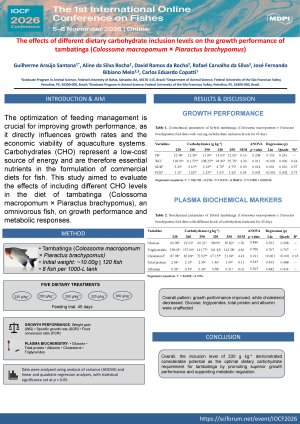
The optimization of feeding management is crucial for improving growth performance, as it directly influences growth rates and the economic viability of aquaculture systems. Carbohydrates (CHO) represent a low-cost source of energy and are therefore essential nutrients in the formulation of commercial diets for fish. This study aimed to evaluate the effects of including different CHO levels in the diet of tambatinga (Colossoma macropomum × Piaractus brachypomus), an omnivorous fish, on growth performance and metabolic responses. Five diets were formulated with graded CHO levels (230, 260, 290, 320, and 350 g kg⁻¹) and fed to fish (initial weight: ~10.00 g) distributed in 15 1,000-L tanks (triplicate groups; n = 8 fish per tank) to apparent satiety for 45 days. Data were analyzed using analysis of variance (ANOVA) and linear and quadratic regression analyses, with statistical significance set at p < 0.05. Diets containing 230 and 260 g kg⁻¹ of CHO resulted in greater weight gain, higher specific growth rate, and lower feed conversion ratio compared with the other dietary treatments. Plasma cholesterol levels showed that lower dietary CHO levels resulted in higher concentrations. No significant differences were observed in plasma glucose, triglyceride, total protein, or albumin levels. Overall, the inclusion level of 230 g kg⁻¹ demonstrated considerable potential as the optimal dietary carbohydrate requirement for tambatinga by promoting superior growth performance and supporting metabolic regulation.
Keywords
aquaculture
dietary requirement
metabolic responses
weight gain.
Poster
Poster-Sciform_Guilherme Araujo.pdf
Natural preservative biofilms based on Salicornia europaea extract and microalgae hydrolysates for European seabass fillets
Trophic reorganization and biomass shifts of fishes driven by ENSO dynamics in a tropical estuary