Event submissions
Published
This submission belongs to the session S2. Sustainable Fisheries and Aquaculture Innovations: Combating Overfishing and Advancing Aquatic Health of the event The 1st International Online Conference on Fishes
Published date
03 Nov, 2026
Academic Editor
 Maria Angeles Esteban
Contribution&Funding
Conceptualization,
[Ajit Antony]
Methodology,
[Ajit Antony] ; [Sonal R Kalbande]
Software,
[Ajit Antony]
Validation,
[Kusum Komal Karati]
Data curation,
[Sonal R Kalbande]
Writing - review,
[editing] ; [Kusum Komal Karati]
Supervision,
[Kusum Komal Karati]
Funding: --
Citation
Ajit Antony, Kusum Komal Karati, Sonal R Kalbande, Larval Transport Dynamics, Spawning Origins, and Nursery Connectivity of Engraulidae and Dorosomatidae Species along the West Coast of India, in Proceedings of The 1st International Online Conference on Fishes, 5 November–6 November 2026, MDPI: Basel, Switzerland
Share
Email
Facebook
Twitter
LinkedIn
Larval Transport Dynamics, Spawning Origins, and Nursery Connectivity of Engraulidae and Dorosomatidae Species along the West Coast of India

Ajit Antony 1
Kusum Komal Karati 2
Sonal R Kalbande 3
1. Department of Marine biology, Kerala University of Fisheries and Ocean Studies, Kochi, 682506, India
2. Fisheries Resource and Habitat Assessment, Centre for Marine Living Resource and Ecology, Kochi, 682506, India
3. Department of Marine Biology, Kerala University of Fisheries and Ocean Studies, Kochi, 682506, India
Abstract
Abstract
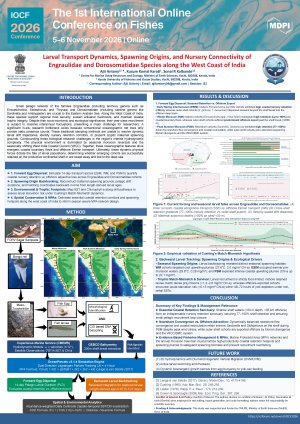
Fish recruitment and larval transport are fundamental to fish population connectivity and the sustainability of fisheries. Ichthyoplankton samples were collected during the Early Spring Intermonsoon (ESIM), Winter Monsoon (WM), and Peak Summer Monsoon (PSM) along the Eastern Arabian Sea. Fish species belonging to the Engraulidae and Dorosomatidae families, identified by a combined approach of morphological and molecular methods, were selected for the present study. We coupled observed ichthyoplankton abundances with a dual-direction Lagrangian particle tracking model (OceanParcels v3.1.4). Dual-direction simulations were executed, including forward simulations for pelagic eggs and backward simulations for larvae, to identify plausible nursery and spawning origins, respectively. Forward simulations of egg dispersal revealed seasonal differences in coastal retention. During the ESIM, simulated inshore-spawned Encrasicholina punctifer cohorts were predicted to exhibit coastal retention and settlement in nursery grounds. In contrast, simulated outer-shelf cohorts of Sardinella gibbosa and Thryssa dussumieri were predicted to disperse offshore. During the WM, complete retention were predicted for inshore cohorts of E. punctifer, Encrasicholina heteroloba, and Hilsa kelee, while offshore export was predicted for S. gibbosa and T. dussumieri. During the PSM, S. gibbosa and Stolephorus cohorts were expected to exhibit coastal retention, whereas other outer-shelf cohorts were predicted to be exported offshore. Backward larval tracking simulated spawning grounds of target cohorts and indicated seasonal differences. During the ESIM, the modelled spawning origins of E. punctifer and S. gibbosa were characterized by higher chlorophyll-a concentrations and cooler sea surface temperatures (SSTs) compared to capture conditions. During the WM, modelled spawning origins of E. punctifer, E. heteroloba, and S. gibbosa exhibited a stronger productive signature, with higher chlorophyll-a and cooler SST. During the PSM, the modelled spawning origins of S. gibbosa and Stolephorus cohorts showed elevated food availability and distinct temperature conditions. Delineating these coastal retention corridors is essential for Marine Protected Area (MPA) design and fisheries management along the west coast of India.
Keywords
Larval transport
Engraulidae
Dorosomatidae
Eastern Arabian Sea
OceanParcels
DNA barcoding
Coastal retention
Spawning habitat suitability.
Poster
IOCF 2026-poster-final.pdf
Trophic reorganization and biomass shifts of fishes driven by ENSO dynamics in a tropical estuary
Relationship between diet composition and anthropogenic particle ingestion in juvenile Cynoscion guatucupa from the Southwestern Atlantic