Event submissions
Published
This submission belongs to the session S1. Climate Change Impact and Marine Pollution of the event The 1st International Online Conference on Fishes
Published date
03 Nov, 2026
Academic Editor
 Pedro Morais
Contribution&Funding
Conceptualization,
[Ana Carolina Ronda] ; [Gabriela Elizabeth Blasina]
Methodology,
[Juana Ariela Pereyra] ; [Gabriela Elizabeth Blasina]
Software,
[Juana Ariela Pereyra]
Validation,
[Juana Ariela Pereyra]
Formal analysis,
[Juana Ariela Pereyra]
Investigation,
[Juana Ariela Pereyra]
Resources,
[Gabriela Elizabeth Blasina]
Data curation,
[Juana Ariela Pereyra] ; [Gabriela Elizabeth Blasina]
Writing - original draft,
[Juana Ariela Pereyra]
Writing - review,
[editing] ; [Ana Carolina Ronda] ; [Gabriela Elizabeth Blasina] ; [Juana Ariela Pereyra]
Visualization,
[Juana Ariela Pereyra]
Supervision,
[Ana Carolina Ronda] ; [Gabriela Elizabeth Blasina]
Project administration,
[Ana Carolina Ronda] ; [Gabriela Elizabeth Blasina]
Funding acquisition,
[Gabriela Elizabeth Blasina]
Funding: --
Citation
Juana Ariela Pereyra, Ana Carolina Ronda, Gabriela Elizabeth Blasina, Relationship between diet composition and anthropogenic particle ingestion in juvenile Cynoscion guatucupa from the Southwestern Atlantic, in Proceedings of The 1st International Online Conference on Fishes, 5 November–6 November 2026, MDPI: Basel, Switzerland
Share
Email
Facebook
Twitter
LinkedIn
Relationship between diet composition and anthropogenic particle ingestion in juvenile Cynoscion guatucupa from the Southwestern Atlantic

Juana Ariela Pereyra 1
Ana Carolina Ronda 2,3
Gabriela Elizabeth Blasina 1,3
1. Department of Biology, Biochemistry and Pharmacy, National University of the South, Bahía Blanca, 8000, Argentina
2. Department of Geography and Tourism, National University of the South, Bahía Blanca, 8000, Argentina
3. Argentine Institute of Oceanography (IADO-CONICET), Bahía Blanca, 8000, Argentina
Abstract
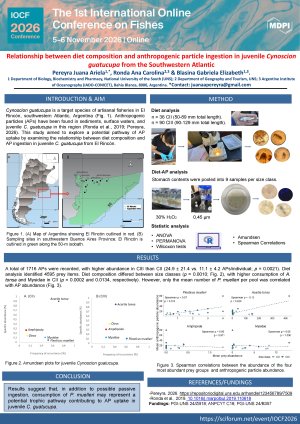
Ingestion of anthropogenic particles (APs) by marine fish is an increasing global concern. We evaluated the relationship between diet composition and AP ingestion in juvenile striped weakfish (Cynoscion guatucupa) from the El Rincón coastal area, Buenos Aires Province, Argentina (Southwestern Atlantic). A total of 126 individuals from two size classes (CII: 50-89 mm and CIII: 90-129 mm total length) were analyzed. Prey items were identified and quantified in individual stomachs, whereas APs were quantified in pooled stomach samples (nine pools per size class). A total of 1716 APs were recorded, with higher abundance in CIII than CII (24.9 ± 21.4 vs. 11.1 ± 4.2 APs/individual; ANOVA, p = 0.0021). Mean particle length was 0.87 ± 0.93 mm, with no differences between size classes (p = 0.5850). Diet analysis identified 4595 prey items, with Acartia tonsa as the most frequent prey (60.32%), followed by Pleoticus muelleri (54.76%) and Mysidae (40.48%). Diet composition differed between size classes (PERMANOVA, p = 0.0010), with higher consumption of A. tonsa and Mysidae in CII (Wilcoxon tests, p = 0.0002 and 0.0134, respectively). Generalized linear models (GLMs) with a negative binomial distribution indicated that AP abundance was influenced by the interaction between total prey number and size class (p = 0.0145), showing a positive association in CIII but not in CII. However, only the mean number of P. muelleri per pool was correlated with AP abundance (Spearman's rho = 0.64, p = 0.0044), a positive association that was also supported by GLMs (p = 0.0017), with no differences in the relationship between size classes. These results suggest that, in addition to possible passive ingestion, consumption of P. muelleri may represent a potential trophic pathway contributing to AP uptake in juvenile C. guatucupa.
Keywords
Marine contamination
Scianidae
Feeding ecology
Trophic transfer
Poster
poster. pereyra juana.pdf
Larval Transport Dynamics, Spawning Origins, and Nursery Connectivity of Engraulidae and Dorosomatidae Species along the West Coast of India
Prevalence and Sex-Based Variation in Parasite Load of Arius maculatus from Chenkalady, Eastern Province, Sri Lanka