Event submissions
Published
This submission belongs to the session S2. Sustainable Fisheries and Aquaculture Innovations: Combating Overfishing and Advancing Aquatic Health of the event The 1st International Online Conference on Fishes
Published date
03 Nov, 2026
Academic Editor
 Maria Angeles Esteban
Contribution&Funding
Conceptualization,
[Shinthuja Nadarajah]
Methodology,
[Shinthuja Nadarajah]
Validation,
[Shinthuja Nadarajah]
Formal analysis,
[Shinthuja Nadarajah]
Investigation,
[Shinthuja Nadarajah]
Resources,
[Shinthuja Nadarajah]
Data curation,
[Shinthuja Nadarajah]
Writing - original draft,
[Shinthuja Nadarajah]
Writing - review,
[editing] ; [Shinthuja Nadarajah]
Visualization,
[Shinthuja Nadarajah]
Supervision,
[Vinobaba Periyathamby]
Project administration,
[Vinobaba Periyathamby]
Funding: --
Citation
Shinthuja Nadarajah, Vinobaba Periyathamby, Prevalence and Sex-Based Variation in Parasite Load of Arius maculatus from Chenkalady, Eastern Province, Sri Lanka, in Proceedings of The 1st International Online Conference on Fishes, 5 November–6 November 2026, MDPI: Basel, Switzerland
Share
Email
Facebook
Twitter
LinkedIn
Prevalence and Sex-Based Variation in Parasite Load of Arius maculatus from Chenkalady, Eastern Province, Sri Lanka

Shinthuja Nadarajah 1
Vinobaba Periyathamby 1
1. Department of Zoology, Eastern University, Vantharumoolai, Chenkalady, Sri Lanka
Abstract
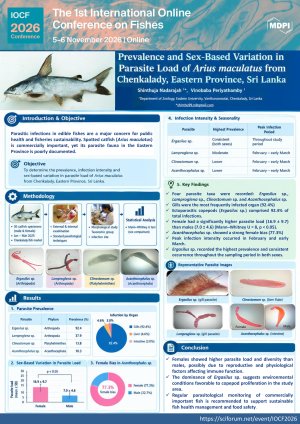
Parasitic infections in edible fishes are a major concern for public health and fisheries sustainability. This study evaluated parasite prevalence, infection intensity and sex-based variation in spotted catfish (Arius maculatus) collected from Chenkalady fish market, Eastern Province, Sri Lanka. Thirty catfish specimens (male and female) were examined externally and internally using standard parasitological techniques from January to March 2025. Parasites were identified morphologically under microscopic observation and classified by taxonomic group and infection site. Statistical analysis was conducted to compare parasite load between sexes using the Mann–Whitney U test. Four parasite taxa were recorded: Ergasilus sp. (Arthropoda), Lamproglena sp. (Arthropoda), Clinostomum sp. (Platyhelminthes) and Acanthocephalus sp. (Acanthocephala). The gills were the most frequently infected organ, with ectoparasitic copepods comprising 92.4% of total infections. Endoparasites were less frequent, with Clinostomum sp. observed in the liver and Acanthocephalus sp. in the intestine. Females had a significantly higher parasite load (16.9 ± 9.7) compared to males (7.0 ± 4.6) (Mann–Whitney U = 8, p < 0.05). Acanthocephalus sp. showed a strong female bias (77.3%). Peak infection intensity occurred in February and early March, with Ergasilus sp. recording the highest prevalence and consistent occurrence throughout the sampling period in both male and female hosts. Female catfish exhibited higher parasite load and diversity than males, possibly due to reproductive and physiological factors affecting immune function. The study highlights that the dominance of Ergasilus sp., suggesting environmental conditions favorable to copepod proliferation in the study area. Regular parasitological monitoring of commercially important fish species in this region is recommended to support sustainable fish health management and food safety.
Keywords
Catfish
Parasites
Copepod
Endoparasites
Ectoparasites
sustainable
Poster
Sciforum-208875 Poster.pdf
Relationship between diet composition and anthropogenic particle ingestion in juvenile Cynoscion guatucupa from the Southwestern Atlantic
Metabolomic Effects of Nicotinamide Mononucleotide and β-Hydroxy-β-Methylbutyrate Supplementation on Muscle of Gilthead Seabream (Sparus aurata).