Event submissions
Published
This submission belongs to the session S2. Sustainable Fisheries and Aquaculture Innovations: Combating Overfishing and Advancing Aquatic Health of the event The 1st International Online Conference on Fishes
Published date
03 Nov, 2026
Academic Editor
 Wagner C. Valenti
Contribution&Funding
Conceptualization,
[Álvaro Sánchez-Ferrer] ; [M Angeles Esteban]
Methodology,
[Álvaro Sánchez-Ferrer] ; [M Angeles Esteban]
Validation,
[Álvaro Sánchez-Ferrer] ; [M Angeles Esteban]
Investigation,
[Úrsula Montalbán-Garrido]
Resources,
[M Angeles Esteban] ; [Álvaro Sánchez-Ferrer]
Data curation,
[Úrsula Montalbán-Garrido]
Writing - original draft,
[Úrsula Montalbán-Garrido]
Writing - review,
[editing] ; [M Angeles Esteban] ; [Álvaro Sánchez-Ferrer] ; [Úrsula Montalbán-Garrido]
Visualization,
[Úrsula Montalbán-Garrido]
Supervision,
[M Angeles Esteban] ; [Álvaro Sánchez-Ferrer]
Project administration,
[M Angeles Esteban] ; [Álvaro Sánchez-Ferrer]
Funding acquisition,
[M Angeles Esteban] ; [Álvaro Sánchez-Ferrer]
Funding: This work was funded by the MICIU (PID2024-156529NB-I00) and Fundación Séneca of the Region of Murcia (23025/GERM/25).
Citation
Úrsula Montalbán-Garrido, M Angeles Esteban, Álvaro Sánchez-Ferrer, Metabolomic Effects of Nicotinamide Mononucleotide and β-Hydroxy-β-Methylbutyrate Supplementation on Muscle of Gilthead Seabream (Sparus aurata)., in Proceedings of The 1st International Online Conference on Fishes, 5 November–6 November 2026, MDPI: Basel, Switzerland
Share
Email
Facebook
Twitter
LinkedIn
Metabolomic Effects of Nicotinamide Mononucleotide and β-Hydroxy-β-Methylbutyrate Supplementation on Muscle of Gilthead Seabream (Sparus aurata).

Úrsula Montalbán-Garrido 1

M Angeles Esteban 1
Álvaro Sánchez-Ferrer 2
1. Department of Cell Biology and Histology, Faculty of Biology, University of Murcia, Murcia, 30100, Spain
2. Department of Biochemistry and Molecular Biology, Faculty of Biology, University of Murcia, Murcia, 30100, Spain
Abstract
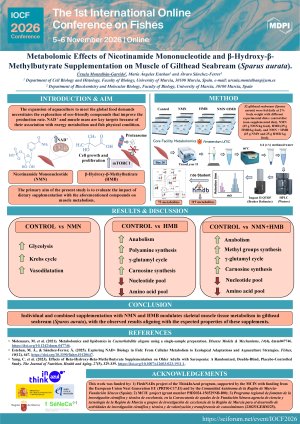
The expansion of aquaculture to meet food demands necessitates the exploration of eco-friendly compounds. Nicotinamide adenine dinucleotide (NAD+) and muscle mass are targets because of their association with energy metabolism and fish condition. This study assessed the effects of dietary supplementation with nicotinamide mononucleotide (NMN; a precursor to NAD+), β-hydroxy-β-methylbutyrate (HMB; a leucine metabolite that promotes muscle growth), or a combination of both on gilthead seabream muscle pathways. Seventy-two specimens were distributed across 12 tanks and fed four experimental diets twice daily for 30 days: control (D-2 Optibream AE 1P), NMN (Age-science, 25 g/kg), HMB (Biosynth, 25 g/kg), and NMN+HMB (25 g/kg each). Polar metabolites were extracted from muscle samples using liquid–liquid extraction. A total of 119 metabolites were identified via HPLC-QTOF-MS (ESI±) based on accurate mass (±5 ppm) and retention time. Of these, 73 were assigned to pathways, including glycolysis, the Krebs cycle, NAD+ biosynthesis, urea metabolism, nucleotide metabolism, methionine metabolism, creatine/phosphocreatine metabolism, and oxidative stress. Student’s t-test was used to compare the treatments with the control. The results indicated that NMN supplementation increased the abundance of lactate, succinate, and argininosuccinate, suggesting modulation of glycolysis and the Krebs cycle and their interaction with the urea cycle. Conversely, HMB supplementation increased the abundance of creatine, choline, and betaine, while reducing energy-related nucleotides (ATP/ADP/UTP) and amino acids. These findings may reflect adjustments in myogenesis and alterations in the creatine–methionine axis of the skeletal muscle. Furthermore, NMN+HMB supplementation resulted in a broader decrease in nucleotides (purines/pyrimidines), 2-phosphoglycerate, amino acids, and redox markers (NADPH and 5-oxoproline), indicating metabolic reorganisation and altered redox homeostasis in the liver. Overall, supplementation treatments modulated gilthead seabream muscle metabolism, consistent with their roles. However, further studies are necessary to determine the optimal supplementation levels.
Keywords
Nicotinamide mononucleotide
β-hydroxy-β-methylbutyrate
metabolomics
gilthead seabream (Sparus aurata)
muscle
energy metabolism
aquaculture
Poster
Poster_Ursula_Montalban_Garrido_IOCF.pdf
Prevalence and Sex-Based Variation in Parasite Load of Arius maculatus from Chenkalady, Eastern Province, Sri Lanka
IMMUNOSTIMULATORY POTENTIAL OF NAD⁺ BOOSTERS: IN VITRO EFFECTS OF NMN AND NR ON HEAD-KIDNEY LEUKOCYTES OF GILTHEAD SEABREAM (SPARUS AURATA)