Event submissions
Events3rd International Electronic and Flipped Conference on Entropy and Its Applications
Published

This submission belongs to the session A. Physics and Engineering of the event 3rd International Electronic and Flipped Conference on Entropy and Its Applications
Published date
07 Nov, 2016
Citation
Ben Akih-Kumgeh, Black Holes and Entropy: A Skeptical Perspective, in Proceedings of 3rd International Electronic and Flipped Conference on Entropy and Its Applications, 1 November–10 November 2016, MDPI: Basel, Switzerland, doi: 10.3390/ecea-3-A006
Share
Email
Facebook
Twitter
LinkedIn
Black Holes and Entropy: A Skeptical Perspective
'%3e%3cpath%20d='M12.6647%2010.9104C12.4176%2010.325%2012.0589%209.7933%2011.6088%209.34485C11.16%208.89511%2010.6283%208.53653%2010.0432%208.28891C10.038%208.28629%2010.0327%208.28498%2010.0275%208.28236C10.8437%207.69282%2011.3743%206.73252%2011.3743%205.64907C11.3743%203.85423%209.92005%202.40002%208.12522%202.40002C6.33038%202.40002%204.87618%203.85423%204.87618%205.64907C4.87618%206.73252%205.40677%207.69282%206.22296%208.28367C6.21772%208.28629%206.21248%208.2876%206.20724%208.29022C5.62031%208.53783%205.09365%208.89287%204.64167%209.34616C4.19192%209.79496%203.83334%2010.3266%203.58573%2010.9117C3.34247%2011.4846%203.21128%2012.0987%203.19925%2012.721C3.1989%2012.735%203.20135%2012.7489%203.20646%2012.7619C3.21157%2012.7749%203.21924%2012.7868%203.22901%2012.7968C3.23877%2012.8068%203.25045%2012.8148%203.26334%2012.8202C3.27623%2012.8256%203.29007%2012.8284%203.30406%2012.8284H4.09012C4.14776%2012.8284%204.19362%2012.7825%204.19493%2012.7262C4.22113%2011.7148%204.62726%2010.7676%205.34519%2010.0497C6.08802%209.30686%207.07452%208.89811%208.12522%208.89811C9.17592%208.89811%2010.1624%209.30686%2010.9052%2010.0497C11.6232%2010.7676%2012.0293%2011.7148%2012.0555%2012.7262C12.0568%2012.7839%2012.1027%2012.8284%2012.1603%2012.8284H12.9464C12.9604%2012.8284%2012.9742%2012.8256%2012.9871%2012.8202C13%2012.8148%2013.0117%2012.8068%2013.0214%2012.7968C13.0312%2012.7868%2013.0389%2012.7749%2013.044%2012.7619C13.0491%2012.7489%2013.0515%2012.735%2013.0512%2012.721C13.0381%2012.0947%2012.9084%2011.4856%2012.6647%2010.9104ZM8.12522%207.90243C7.52388%207.90243%206.95792%207.66793%206.53214%207.24215C6.10636%206.81636%205.87185%206.2504%205.87185%205.64907C5.87185%205.04773%206.10636%204.48177%206.53214%204.05599C6.95792%203.63021%207.52388%203.3957%208.12522%203.3957C8.72655%203.3957%209.29252%203.63021%209.7183%204.05599C10.1441%204.48177%2010.3786%205.04773%2010.3786%205.64907C10.3786%206.2504%2010.1441%206.81636%209.7183%207.24215C9.29252%207.66793%208.72655%207.90243%208.12522%207.90243Z'%20fill='%235D1EE1'/%3e%3c/g%3e%3c/svg%3e)
Ben Akih-Kumgeh 1
1. Department of Mechanical and Aerospace Engineering, Syracuse University
Abstract
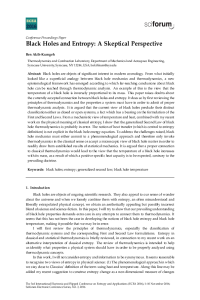
Black holes are objects of significant interest in modern cosmology. From what initially looked like a superficial analogy between black hole mechanics and thermodynamics, a new epistemological framework has emerged according to which far-reaching conclusions about black hole can be reached through thermodynamic analysis. An example of this is the view that the temperature of a black hole is inversely proportional to its mass. This paper raises doubts about the currently accepted connection between black holes and entropy. It does so by first reviewing the principles of thermodynamics and the properties a system must have in order to admit of proper thermodynamic analysis. It is argued that the current view of black holes preclude their distinct classification either as closed or open systems, a fact which has a bearing on the formulation of the First and Second Laws. From a mechanistic view of temperature and heat, combined with my recent work on the physical meaning of classical entropy, I show that the generalized Second Law of black hole thermodynamics is probably in error. The notion of heat transfer (which is central to entropy definition) is not explicit in the black hole energy equation. To address the challenges raised, black hole mechanics must either commit to a phenomenological approach and therefore only invoke thermodynamics in the classical sense or accept a microscopic view of black hole matter in order to readily draw from established results of statistical mechanics. It is argued that a proper connection to classical thermodynamics would lead to the view that the temperature of a black hole increases with its mass, as a result of which a positive specific heat capacity is to be expected, contrary to the prevailing doctrine.
Keywords
black hole
entropy
black hole thermodynamics
negative specific heat capacity
Second Law of Thermodynamics
Manuscript
A006-original.pdf
Poster
A006-original.pdf
A Possible Role for Entropy in Creative Cognition