Event submissions
Published
This submission belongs to the session S2. Sustainable Fisheries and Aquaculture Innovations: Combating Overfishing and Advancing Aquatic Health of the event The 1st International Online Conference on Fishes
Published date
03 Nov, 2026
Academic Editor
 Wagner C. Valenti
Contribution&Funding
Conceptualization,
[María Ángeles Esteban]
Methodology,
[María Ortiz]
Formal analysis,
[María Ortiz]
Investigation,
[María Ortiz] ; [María Ángeles Esteban]
Resources,
[María Ángeles Esteban]
Data curation,
[María Ortiz]
Writing - original draft,
[María Ortiz] ; [María Ángeles Esteban]
Writing - review,
[editing] ; [María Ortiz] ; [María Ángeles Esteban]
Visualization,
[María Ortiz]
Supervision,
[María Ángeles Esteban]
Project administration,
[María Ángeles Esteban]
Funding acquisition,
[María Ángeles Esteban]
Funding: María Ortiz holds a grant from the Seneca Foundation (22303/FPI/23). This research was funded by the MCIU project (PID2024-156529NB-I00) and the Seneca Foundation’s Excellence Groups program (23025/GERM/25).
Citation
María Ortiz, María Ángeles Esteban, IN VITRO EFFECTS OF NAD⁺ BOOSTERS ON VIABILITY, MITOCHONDRIAL BIOENERGETICS AND MIGRATION IN SAF-1 CELLS, in Proceedings of The 1st International Online Conference on Fishes, 5 November–6 November 2026, MDPI: Basel, Switzerland
Share
Email
Facebook
Twitter
LinkedIn
IN VITRO EFFECTS OF NAD⁺ BOOSTERS ON VIABILITY, MITOCHONDRIAL BIOENERGETICS AND MIGRATION IN SAF-1 CELLS

María Ortiz 1

María Ángeles Esteban 1
1. Department of Cell Biology and Histology, University of Murcia, Murcia, 30100, Spain
Abstract
Introduction
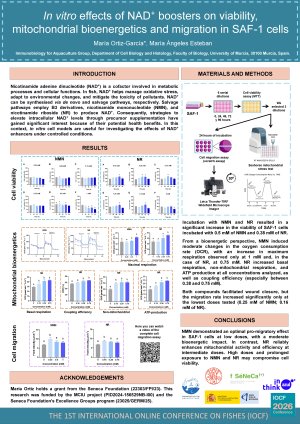
Nicotinamide adenine dinucleotide (NAD⁺) is a cofactor involved in metabolic processes and cellular functions. In fish, NAD⁺ helps manage oxidative stress, adapt to environmental changes, and mitigate the toxicity of pollutants. NAD⁺ can be synthesised via de novo and salvage pathways. Salvage pathways employ B3 derivatives, nicotinamide mononucleotide (NMN), and nicotinamide riboside (NR) to produce NAD⁺. Consequently, strategies to elevate intracellular NAD⁺ levels through precursor supplementation have gained significant interest because of their potential health benefits. In this context, in vitro cell models are useful for investigating the effects of NAD⁺ enhancers under controlled conditions.
Methods
This study investigated the effects of two NAD⁺ enhancers, NMN and NR, on in vitro viability (MTT assay), mitochondrial function (Agilent Seahorse XF), and migration (scratch assay) of the established cell line SAF-1 (ECACC n°00122301).
Results
NMN did not exhibit significant cytotoxicity at concentrations up to 0.5 mM. Conversely, NR either maintained or transiently enhanced viability at low to moderate concentrations, whereas a concentration of 5 mM resulted in a decrease in viability to approximately 60% at 96 h. Regarding bioenergetics, NMN induced only modest alterations, with a notable increase in maximal respiration observed only at 1 mM. In contrast, NR significantly increased basal respiration within the range of 0.16–0.75 mM, as well as ATP-linked respiration and coupling efficiency, without causing significant changes in proton leakage. However, NR elevated non-mitochondrial oxygen consumption, indicating the need to evaluate the role of reactive oxygen species. In the wound closure assay, both NMN and NR facilitated progressive closure only at their lowest concentrations.
Conclusions
NMN demonstrated an optimal promigratory effect on SAF-1 cells at low doses, with moderate bioenergetic impact. Conversely, NR reliably enhances mitochondrial activity and efficiency at intermediate doses. High doses and prolonged exposure to NMN and NR may compromise cell viability.
Keywords
NAD⁺ boosters
NMN (Nicotinamide mononucleotide)
NR (Nicotinamide riboside)
Gilthead seabream (Sparus aurata)
SAF-1
Seahorse
Cell migration
Cell viability
Poster
Poster IOCF26 M. Ortiz.pdf
IMMUNOSTIMULATORY POTENTIAL OF NAD⁺ BOOSTERS: IN VITRO EFFECTS OF NMN AND NR ON HEAD-KIDNEY LEUKOCYTES OF GILTHEAD SEABREAM (SPARUS AURATA)
Functional and Spectroscopic (FTIR) Characterization of Tenebrio molitor Meal Subjected to Lactobacillus acidophilus Fermentation