Event submissions
Published
This submission belongs to the session S2. Sustainable Fisheries and Aquaculture Innovations: Combating Overfishing and Advancing Aquatic Health of the event The 1st International Online Conference on Fishes
Published date
03 Nov, 2026
Academic Editor
 Maria Angeles Esteban
Contribution&Funding
Conceptualization,
[Mariana Bender]
Methodology,
[Mariana Bender]
Validation,
[Mariana Bender]
Investigation,
[Mariana Bender] ; [DENISE FAGUNDES BORTOLUZZI]
Writing - original draft,
[Mariana Bender] ; [DENISE FAGUNDES BORTOLUZZI]
Writing - review,
[editing] ; [DENISE FAGUNDES BORTOLUZZI]
Supervision,
[Thiago El Hadi Perez Fabregat]
Funding: --
Citation
Mariana Bender, DENISE FAGUNDES BORTOLUZZI, Thiago El Hadi Perez Fabregat, Functional and Spectroscopic (FTIR) Characterization of Tenebrio molitor Meal Subjected to Lactobacillus acidophilus Fermentation, in Proceedings of The 1st International Online Conference on Fishes, 5 November–6 November 2026, MDPI: Basel, Switzerland
Share
Email
Facebook
Twitter
LinkedIn
Functional and Spectroscopic (FTIR) Characterization of Tenebrio molitor Meal Subjected to Lactobacillus acidophilus Fermentation

Mariana Bender 1
DENISE FAGUNDES BORTOLUZZI 1
Thiago El Hadi Perez Fabregat 2
1. Graduate Program in Animal Science , UDESC-CAV, Lages, 88520-000, Brazil
2. Department of Animal Production and Food , UDESC-CAV, Lages, 88520-000, Brazil
Abstract
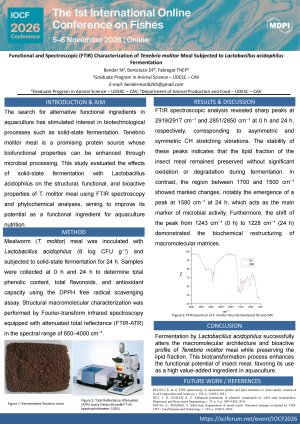
INTRODUCTION: The search for alternative and functional ingredients for aquatic nutrition has driven the application of biotechnological processes, such as solid-state fermentation. Tenebrio molitor meal stands out as a promising protein source; however, its biofunctional properties can be enhanced through microbial processing. The evaluation of changes in structural functional groups, combined with the phytochemical profile, provides valuable data on the biochemical transformations promoted by lactic acid bacteria. METHODOLOGY: Mealworm (T. molitor) meal was inoculated with Lactobacillus acidophilus (8 log CFU g⁻¹) and subjected to solid-state fermentation for 24 h. Samples were collected at 0 h and 24 h to determine total phenolic content, total flavonoids, and antioxidant capacity using the DPPH free radical scavenging assay. Structural macromolecular characterization was performed by Fourier-transform infrared spectroscopy equipped with attenuated total reflectance (FTIR-ATR) in the spectral range of 650–4000 cm⁻¹. RESULTS: FTIR spectroscopic analysis revealed sharp peaks at 2919/2917 cm⁻¹ and 2851/2850 cm⁻¹ at 0 h and 24 h, respectively, corresponding to asymmetric and symmetric CH stretching vibrations. The stability of these peaks indicates that the lipid fraction of the insect meal remained preserved without significant oxidation or degradation during fermentation. In contrast, the region between 1700 and 1500 cm⁻¹ showed marked changes, notably the emergence of a peak at 1580 cm⁻¹ at 24 h, which acts as the main marker of microbial activity. Furthermore, the shift of the peak from 1243 cm⁻¹ (0 h) to 1228 cm⁻¹ (24 h) demonstrated the biochemical restructuring of macromolecular matrices. This structural reorganization promoted by L. acidophilus was accompanied by modulation in the levels of total phenolics, flavonoids, and antioxidant capacity of the fermented meal. CONCLUSION: Fermentation by Lactobacillus acidophilus successfully alters the macromolecular architecture and bioactive profile of Tenebrio molitor meal while preserving the lipid fraction. This biotransformation process enhances the functional potential of insect meal, favoring its use as a high value-added ingredient in aquaculture.
Keywords
Antioxidant activity; Biofunctional ingredients; FTIR spectroscopy; Lactic acid bacteria; Tenebrio molitor meal.
Poster
poster tenebrio 2026.pdf
IN VITRO EFFECTS OF NAD⁺ BOOSTERS ON VIABILITY, MITOCHONDRIAL BIOENERGETICS AND MIGRATION IN SAF-1 CELLS
Capture area and macroplastic ingestion as factors of body condition in a potential deep-sea indicator species