Event submissions
Published
This submission belongs to the session S4. Behavioral Ecology of Aquatic Animals: Implications for Habitat Conservation and Ecosystem Services of the event The 1st International Online Conference on Fishes
Published date
03 Nov, 2026
Academic Editor
 Maria Angeles Esteban
Contribution&Funding
Conceptualization,
[DENISE FAGUNDES BORTOLUZZI] ; [Nataly Neves Oliveira dos Santos]
Methodology,
[Fernanda regina Delziovo ] ; [Nataly Neves Oliveira dos Santos] ; [DENISE FAGUNDES BORTOLUZZI] ; [mariana bender]
Validation,
[mariana bender] ; [DENISE FAGUNDES BORTOLUZZI]
Investigation,
[DENISE FAGUNDES BORTOLUZZI] ; [Fernanda regina Delziovo ] ; [mariana bender]
Data curation,
[mariana bender]
Writing - original draft,
[DENISE FAGUNDES BORTOLUZZI] ; [mariana bender]
Writing - review,
[editing] ; [DENISE FAGUNDES BORTOLUZZI] ; [Nataly Neves Oliveira dos Santos]
Supervision,
[Thiago el hadi perez Fabregat]
Funding: --
Citation
mariana bender, DENISE FAGUNDES BORTOLUZZI, Nataly Neves Oliveira dos Santos, Fernanda regina Delziovo , Thiago el hadi perez Fabregat, Environmental Enrichment with Aquatic Plants: Impact of Choice Environment on Performance of Bettas (Betta splendens)
, in Proceedings of The 1st International Online Conference on Fishes, 5 November–6 November 2026, MDPI: Basel, Switzerland
Share
Email
Facebook
Twitter
LinkedIn
Environmental Enrichment with Aquatic Plants: Impact of Choice Environment on Performance of Bettas (Betta splendens)

mariana bender 1
DENISE FAGUNDES BORTOLUZZI 1
Nataly Neves Oliveira dos Santos 1
Fernanda regina Delziovo 1
Thiago el hadi perez Fabregat 2
1. Ciência animal, Universidade do Estado de Santa Catarina, Lages, 88520-000, Brazil
2. Department of Animal Production and Food, Universidade do Estado de Santa Catarina, Lages, 88520-000, Brazil
Abstract
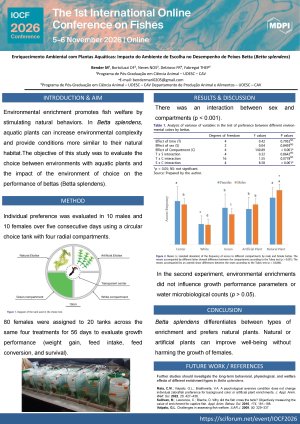
INTRODUCTION: Environmental enrichment is a key strategy for promoting the welfare of captive fish by allowing the expression of environmental preferences and natural behaviors. For Betta splendens, a species native to slow-moving, lentic environments with dense vegetation, traditional simplified rearing containers restrict their natural behavioral repertoire. Introducing aquatic plants emerges as a practical alternative to increase structural complexity. METHODOLOGY: The study was conducted in two phases. First, individual preference was evaluated in 10 males and 10 females over five consecutive days using a circular choice tank with four radial compartments: natural plant (Egeria densa), artificial plant, green compartment, and white compartment, plus a neutral central area. In the second phase, 80 females were assigned to 20 tanks across the same four treatments for 56 days to evaluate growth performance (weight gain, feed intake, feed conversion, and survival) and water microbiology (lactic acid bacteria, heterotrophic bacteria, and Vibrio sp.). RESULTS: Both males and females showed a significant preference for compartments containing natural plants over other choices (p < 0.001), with this preference being more pronounced in males (p = 0.0286). High occupancy was also observed in the central area for both sexes, suggesting environmental vigilance and territorial behavior. In the second experiment, environmental enrichments did not influence growth performance parameters or water microbiological counts (p > 0.05). CONCLUSION: Based on the results, male and female Betta splendens showed a clear preference for environments containing natural plants. The use of different types of environmental enrichment did not affect the growth performance of female bettas. Therefore, natural and artificial plants, as well as green-colored environments, can be used as environmental enrichment during breeding without compromising zootechnical performance. Nevertheless, the preference results indicate that natural plants may be more attractive to bettas than artificial plants.
Keywords
Environmental enrichment; fish welfare; macrophytes; ornamental fish
Poster
poster betta 2026.pdf
Capture area and macroplastic ingestion as factors of body condition in a potential deep-sea indicator species
Effect of feed deprivation at different water pH levels on the performance and hematology of tambaqui