Event submissions
Published
This submission belongs to the session S2. Sustainable Fisheries and Aquaculture Innovations: Combating Overfishing and Advancing Aquatic Health of the event The 1st International Online Conference on Fishes
Published date
03 Nov, 2026
Academic Editor
 Maria Angeles Esteban
Contribution&Funding
Conceptualization,
[Carlos Eduardo Copatti] ; [VANESSA Ferreira Batista]
Methodology,
[VANESSA Ferreira Batista] ; [José Fernando Bibiano Melo] ; [Gilmar Amaro Pereira] ; [Rafael Silva Marchão]
Formal analysis,
[Rafael Silva Marchão]
Investigation,
[Mychelle da Silva Costa] ; [Rafael Silva Marchão] ; [VANESSA Ferreira Batista]
Resources,
[Jane Mello Lopes] ; [Marcos Antonio Delmondes Bomfim] ; [Carlos Eduardo Copatti] ; [Felipe Barbosa Ribeiro]
Data curation,
[Carlos Eduardo Copatti] ; [Rafael Silva Marchão] ; [VANESSA Ferreira Batista]
Writing - original draft,
[VANESSA Ferreira Batista]
Writing - review,
[editing] ; [Rafael Silva Marchão] ; [Carlos Eduardo Copatti] ; [VANESSA Ferreira Batista] ; [Jane Mello Lopes]
Visualization,
[VANESSA Ferreira Batista]
Supervision,
[Carlos Eduardo Copatti]
Project administration,
[Carlos Eduardo Copatti]
Funding acquisition,
[Carlos Eduardo Copatti]
Funding: Coordenação de Aperfeiçoamento de Pessoal de Nível Superior - CAPES 001 e Fundação de Amparo à Pesquisa e ao Desenvolvimento Científico e Tecnológico do Maranhão - FAPEMA
Citation
VANESSA Ferreira Batista, Felipe Barbosa Ribeiro, Jane Mello Lopes, Marcos Antonio Delmondes Bomfim, Mychelle da Silva Costa, Rafael Silva Marchão, Gilmar Amaro Pereira, José Fernando Bibiano Melo, Carlos Eduardo Copatti, Effect of feed deprivation at different water pH levels on the performance and hematology of tambaqui, in Proceedings of The 1st International Online Conference on Fishes, 5 November–6 November 2026, MDPI: Basel, Switzerland
Share
Email
Facebook
Twitter
LinkedIn
Effect of feed deprivation at different water pH levels on the performance and hematology of tambaqui

VANESSA Ferreira Batista 1
Felipe Barbosa Ribeiro 2
Jane Mello Lopes 3
Marcos Antonio Delmondes Bomfim 2
Mychelle da Silva Costa 3
Rafael Silva Marchão 2
Gilmar Amaro Pereira 4
José Fernando Bibiano Melo 4

Carlos Eduardo Copatti 5
1. Graduate Program in Biodiversity and Evolution, Federal University of Bahia (UFBA), Salvador, BA, Brazil
2. Graduate Program in Animal Science, Federal University of Maranhão (UFMA), Chapadinha, MA, Brazil
3. Ciências Biológicas, Universidade Federal do Maranhão (UFMA), Chapadinha, 65500-000, Brazil
4. Zootecnia, Universidade Federal do Vale do São Francisco (UNIVASF), Petrolina, 56300-000, Brazil
5. Ciências Biológicas, Universidade Federal da Bahia (UFBA), Salvador, 40170-110, Brazil
Abstract
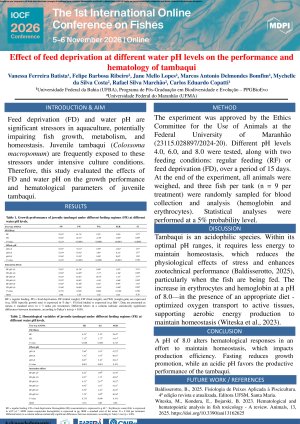
Feed deprivation and water pH are important stressors in aquaculture that can impair fish growth, metabolism, and homeostasis. Juvenile tambaqui (Colossoma macropomum) are frequently exposed to these stressors under intensive farming conditions. Therefore, this study evaluated the effects of feed deprivation and water pH on the growth performance and hematological parameters of juvenile tambaqui. A total of 180 fish (52.00 ± 0.06 g) were assigned to a completely randomized 3 × 2 factorial design consisting of three water pH levels (4.0, 6.0, and 8.0) and two feeding regimes (regular feeding [RF] and feed deprivation [FD]) for 15 days. Growth performance and hematological variables were analyzed using two-way ANOVA followed by Tukey's test (P < 0.05). Fish in the RF groups exhibited greater final weights, weight gain, and specific growth rates (P < 0.05), whereas FD significantly reduced these performance indicators. The greatest growth performance was observed in fish maintained at pH 6.0 under RF, indicating that this condition is optimal for tambaqui growth. In contrast, the combination of FD and pH 4.0 or 8.0 resulted in the poorest zootechnical performance (P < 0.05). Regarding hematological responses, fed fish showed higher hemoglobin concentrations and erythrocyte counts than fish subjected to FD (P < 0.05). In addition, exposure to pH 8.0 increased these parameters, particularly under RF, suggesting a compensatory response to meet the higher metabolic demand imposed by the alkaline environment (P < 0.05). In conclusion, both feed availability and water pH influence tambaqui growth performance. Maintaining fish at pH 6.0 promotes optimal zootechnical performance, whereas pH 8.0 induces compensatory hematological adjustments without improving growth, indicating a greater physiological cost associated with maintaining homeostasis.
Keywords
Aquaculture
Colossoma macropomum
growth
physiology
Poster
CONGRESSO FISHES VANESSA.pdf
Environmental Enrichment with Aquatic Plants: Impact of Choice Environment on Performance of Bettas (Betta splendens)
Oral AMPs increase vaccination potential against nodavirus in European sea bass