Event submissions
Published
This submission belongs to the session S2. Sustainable Fisheries and Aquaculture Innovations: Combating Overfishing and Advancing Aquatic Health of the event The 1st International Online Conference on Fishes
Published date
03 Nov, 2026
Academic Editor
 Wagner C. Valenti
Contribution&Funding
Conceptualization,
[Melaku Tafese Awulachew]
Methodology,
[Melaku Tafese Awulachew]
Software,
[Melaku Tafese Awulachew]
Validation,
[Melaku Tafese Awulachew]
Formal analysis,
[Melaku Tafese Awulachew]
Investigation,
[Melaku Tafese Awulachew]
Resources,
[Melaku Tafese Awulachew]
Data curation,
[Melaku Tafese Awulachew]
Writing - original draft,
[Melaku Tafese Awulachew]
Writing - review,
[editing] ; [Melaku Tafese Awulachew]
Visualization,
[Melaku Tafese Awulachew]
Supervision,
[Melaku Tafese Awulachew]
Project administration,
[Melaku Tafese Awulachew]
Funding acquisition,
[Melaku Tafese Awulachew]
Funding: --
Citation
Melaku Tafese Awulachew, Artificial Intelligence for Sustainable Aquaculture and Fish Processing: Advancing Aquatic Health, Quality Assessment, and Value-Chain Optimization, in Proceedings of The 1st International Online Conference on Fishes, 5 November–6 November 2026, MDPI: Basel, Switzerland
Share
Email
Facebook
Twitter
LinkedIn
Artificial Intelligence for Sustainable Aquaculture and Fish Processing: Advancing Aquatic Health, Quality Assessment, and Value-Chain Optimization

Melaku Tafese Awulachew 1
1. Food science and Nutrition Research Diroctrate, Ethiopian Institute Of Agricultural Research, Addis Ababa, P O. Box: 2003, Ethiopia
Abstract
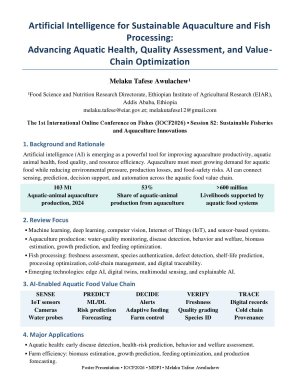
Artificial intelligence (AI) is increasingly transforming fisheries and aquaculture by enabling data-driven approaches to improve aquatic animal health, production efficiency, resource management, and food quality. This review synthesizes recent advances in machine learning, deep learning, computer vision, and Internet of Things (IoT)-enabled technologies across aquaculture and post-harvest fish processing, with particular emphasis on their contributions to sustainable aquatic food systems. The review examines applications in real-time water-quality monitoring, early detection and prediction of fish diseases, behavioral and welfare assessment, biomass estimation, feeding optimization, growth prediction, and farm-level decision support. AI-enabled computer vision and sensor-based systems can facilitate non-invasive monitoring of fish health and production performance while improving feed-use efficiency and reducing environmental impacts associated with aquaculture operations. Beyond production, AI supports fish freshness assessment, species authentication, defect detection, shelf-life prediction, processing optimization, cold-chain management, and digital traceability, thereby reducing post-harvest losses and strengthening food safety. The review further highlights emerging integration of AI with edge computing, digital twins, multimodal sensing, and explainable AI to enable more autonomous and resilient aquaculture systems. Despite substantial progress, widespread adoption remains constrained by limited high-quality and representative datasets, lack of model transferability across species and production environments, infrastructure and connectivity limitations, low algorithmic interpretability, cybersecurity issues, data governance, and regulatory challenges. Future research should prioritize standardized datasets, explainable and energy-efficient AI, interoperable sensing platforms, and validation under diverse real-world aquaculture conditions. Overall, responsible integration of AI across aquaculture production and fish-processing chains offers significant potential to enhance aquatic health, resource-use efficiency, food safety, economic resilience, and the sustainability of global aquatic food systems.
Keywords
Artificial intelligence; Fish processing; Aquaculture; Food quality; Computer vision; Sustainable fisheries; Digital traceability
Poster
Artificial Intelligence for Sustainable Aquaculture and Fish Processing- Advancing Aquatic Health, Quality Assessment, and Value-Chain Optimization.pdf
Oral AMPs increase vaccination potential against nodavirus in European sea bass
Biochemical Biomarkers and Organ-Level Histopathology in African Catfish (Clarias gariepinus) Exposed to Sublethal 2,2-Dichlorovinyl Dimethyl Phosphate (Dichlorvos) Concentrations