Event submissions
Published
This submission belongs to the session S3. Genetics and Genomics of the event The 1st International Online Conference on Fishes
Published date
03 Nov, 2026
Academic Editor
 Eric Hallerman
Contribution&Funding
Conceptualization,
[Alberto Cuesta]
Methodology,
[Alberto Cuesta]
Software,
[Alberto Cuesta]
Resources,
[Alberto Cuesta]
Writing - original draft,
[Alberto Cuesta]
Writing - review,
[editing] ; [Alberto Cuesta]
Project administration,
[Alberto Cuesta]
Funding acquisition,
[Alberto Cuesta]
Funding: PID2022-139492NB-I00, funded by MICIU/AEI/10.13039/501100011033 and by ERDF/EU to A.C., and 23025/GERM/25, funded by FSRM/10.13039/100007801.
Citation
Alberto Cuesta, Single-Cell RNA Transcriptomics Reveal European Sea Bass Brain Atlas and Changes Provoked by Nodavirus Infection, in Proceedings of The 1st International Online Conference on Fishes, 5 November–6 November 2026, MDPI: Basel, Switzerland
Share
Email
Facebook
Twitter
LinkedIn
Single-Cell RNA Transcriptomics Reveal European Sea Bass Brain Atlas and Changes Provoked by Nodavirus Infection

Alberto Cuesta 1,2
1. Cell Biology and Histology, University of Murcia, Murcia, 30100, Spain
2. Marine Science Institute (UMUMAR), University of Murcia, Murcia, 30100, Spain
Abstract
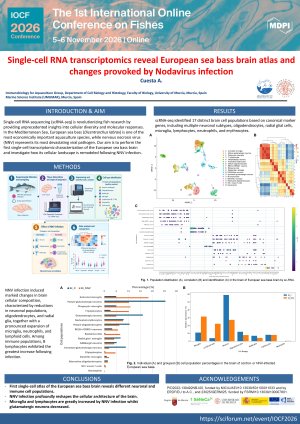
Single-cell RNA sequencing (scRNA-seq) is revolutionizing fish research by providing unprecedented insights into cellular diversity and molecular responses. In the Mediterranean Sea, European sea bass (Dicentrarchus labrax) is one of the most economically important aquaculture species, while nervous necrosis virus (NNV) represents its most devastating viral pathogen. Here, we provide the first single-cell transcriptomic characterization of the European sea bass brain and investigate how its cellular landscape is remodeled following NNV infection. European sea bass were experimentally infected with the RG genotype of NNV, and brain samples were collected 8 days post-infection. Brain tissues were dissociated into single-cell suspensions, processed using the 10x Genomics Chromium platform, sequenced, and analyzed with the Seurat pipeline. scRNA-seq identified 17 distinct brain cell populations based on canonical marker genes, including multiple neuronal subtypes, oligodendrocytes, radial glial cells, microglia, lymphocytes, neutrophils, and erythrocytes. NNV infection induced marked changes in brain cellular composition, characterized by reductions in neuronal populations, oligodendrocytes, and radial glia, together with a pronounced expansion of microglia, neutrophils, and lymphoid cells. Among immune populations, B lymphocytes exhibited the greatest increase following infection. This study provides the first single-cell atlas of the European sea bass brain and demonstrates the power of scRNA-seq for investigating host responses to viral infection in fish. Our findings reveal that NNV profoundly reshapes the cellular architecture of the brain, highlighting extensive neuroimmune remodeling during infection and providing a valuable resource for future studies on fish neuroimmunology and viral pathogenesis.
Keywords
scRNA-seq; European sea bass; Brain atlas; Nodavirus; Neuroimmunology
Poster
Poster scRNA.pdf
Biochemical Biomarkers and Organ-Level Histopathology in African Catfish (Clarias gariepinus) Exposed to Sublethal 2,2-Dichlorovinyl Dimethyl Phosphate (Dichlorvos) Concentrations
Virome analysis in wild fish from the Mar Menor lagoon (SE, Spain)