Event submissions
Published
This submission belongs to the session S4. Behavioral Ecology of Aquatic Animals: Implications for Habitat Conservation and Ecosystem Services of the event The 1st International Online Conference on Fishes
Published date
03 Nov, 2026
Academic Editor
 Pedro Morais
Contribution&Funding
Conceptualization,
[Alberto Cuesta] ; [Mar Torralva]
Methodology,
[Ana C. Hernández-Sendra] ; [José G. Olveira] ; [Alberto Cuesta] ; [Mar Torralva] ; [Francisco José Oliva-Paterna]
Software,
[José G. Olveira]
Validation,
[Alberto Cuesta]
Formal analysis,
[José G. Olveira] ; [Alberto Cuesta]
Investigation,
[Alberto Cuesta] ; [Carlos P. Dopazo] ; [José G. Olveira]
Resources,
[Carlos P. Dopazo] ; [Alberto Cuesta]
Data curation,
[Alberto Cuesta] ; [José G. Olveira]
Writing - original draft,
[Alberto Cuesta]
Writing - review,
[editing] ; [Alberto Cuesta] ; [Ana C. Hernández-Sendra] ; [Mar Torralva] ; [Francisco José Oliva-Paterna] ; [Carlos P. Dopazo] ; [José G. Olveira]
Visualization,
[Alberto Cuesta]
Supervision,
[Alberto Cuesta]
Project administration,
[Alberto Cuesta]
Funding acquisition,
[Alberto Cuesta]
Funding: PID2022-139492NB-I00 and PREP2022-000442, funded by MICIU/AEI/10.13039/501100011033; 23025/GERM/25, funded by FSRM/10.13039/100007801. This study forms part of the ThinkInAzul programme and was supported by MCIU with funding from European Union NextGenera
Citation
Ana C. Hernández-Sendra, José G. Olveira, Carlos P. Dopazo, Francisco José Oliva-Paterna, Mar Torralva, Alberto Cuesta, Virome analysis in wild fish from the Mar Menor lagoon (SE, Spain), in Proceedings of The 1st International Online Conference on Fishes, 5 November–6 November 2026, MDPI: Basel, Switzerland
Share
Email
Facebook
Twitter
LinkedIn
Virome analysis in wild fish from the Mar Menor lagoon (SE, Spain)

Ana C. Hernández-Sendra 1
José G. Olveira 2

Carlos P. Dopazo 2
Francisco José Oliva-Paterna 3
Mar Torralva 3
Alberto Cuesta 1
1. Cell Biology and Histology, University of Murcia, Murcia, 30100, Spain
2. Aquatic One Health Research Center (ARCUS), Universidade de Santiago de Compostela , Santiago de Compostela , 15782, Spain
3. Department of Zoology and Physical Anthropology, University of Murcia, Murcia, 30100, Spain
Abstract
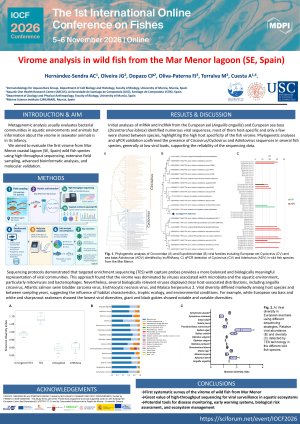
Metagenomic analysis usually evaluates bacterial communities in aquatic environments and animals but information about the virome in seawater animals is in its infancy. Thus, this study provides the first comprehensive characterization of the virome of wild animal species inhabiting the Mar Menor coastal lagoon (SE, Spain). For this, we evaluated the fish virome using high-throughput sequencing, extensive field sampling, advanced bioinformatic analyses, and molecular validation with 103 wild fish representing 15 species.
Initial analyses of mRNA and lncRNA from the European eel (Anguilla anguilla) and European sea bass (Dicentrarchus labrax) identified numerous viral sequences, most of them host-specific and only a few were shared between species, highlighting the high host specificity of the fish virome. Phylogenetic analyses and qPCR validation confirmed the presence of Circovirus/Cyclovirus and Adintovirus sequences in several fish species, generally at low viral loads, supporting the reliability of the sequencing data. Sequencing protocols were further optimized by comparing different methodologies, demonstrating that targeted enrichment sequencing (TES) with capture probes provides a more balanced and biologically meaningful representation of viral communities. This approach found that the virome was dominated by viruses associated with microbiota and the aquatic environment, particularly mitoviruses and bacteriophages. Nevertheless, several biologically relevant viruses displayed clear host-associated distributions, including Anguilla anguilla circovirus, Atlantic salmon swim bladder sarcoma virus, Erythrocytic necrosis virus, and Malaco herpesvirus 2. Viral diversity differed markedly among host species and between sampling years, suggesting the influence of habitat characteristics, trophic ecology, and environmental conditions. For example, while European sea bass and white and sharpsnout seabream showed the lowest viral diversities, giant and black gobies showed notable and variable diversities.
Overall, this study represents the first systematic survey of the virome of multiple wild animal species fromMar Menor and demonstrates the value of high-throughput sequencing for viral surveillance in aquatic ecosystems, providing essential information for disease monitoring, early warning systems, biological risk assessment, and ecosystem management.
Keywords
Viromics; Virome; wild fish; Mar Menor; Circovirus; Adintovirus; European eel and sea bass
Poster
Poster Viroma.pdf
Single-Cell RNA Transcriptomics Reveal European Sea Bass Brain Atlas and Changes Provoked by Nodavirus Infection
Effects of dietary supplementation with piscidin 1 on the activity of digestive enzymes in gilthead seabream (Sparus aurata)