Event submissions
Published
This submission belongs to the session S2. Sustainable Fisheries and Aquaculture Innovations: Combating Overfishing and Advancing Aquatic Health of the event The 1st International Online Conference on Fishes
Published date
03 Nov, 2026
Academic Editor
 Maria Angeles Esteban
Contribution&Funding
Conceptualization,
[Luis Otávio Brito] ; [Gênison Carneiro da Silva]
Methodology,
[Luis Otávio Brito] ; [Gênison Carneiro da Silva]
Software,
[Gênison Carneiro da Silva]
Validation,
[Gênison Carneiro da Silva] ; [Luis Otávio Brito]
Formal analysis,
[Gênison Carneiro da Silva] ; [Luis Otávio Brito]
Investigation,
[Tiago Pereira Matos] ; [Gênison Carneiro da Silva]
Resources,
[Luis Otávio Brito]
Data curation,
[Tiago Pereira Matos]
Writing - original draft,
[Tiago Pereira Matos]
Writing - review,
[editing] ; [Luis Otávio Brito]
Visualization,
[Tiago Pereira Matos]
Supervision,
[Gênison Carneiro da Silva] ; [Luis Otávio Brito]
Project administration,
[Luis Otávio Brito] ; [Gênison Carneiro da Silva]
Funding acquisition,
[Luis Otávio Brito]
Funding: FACEPE
Citation
Tiago Pereira Matos, Luis Otávio Brito, Gênison Carneiro da Silva, Effect of mannan oligosaccharide and nucleotide supplementation on the zootechnical performance and differential and total hemocyte count of Penaeus vannamei subjected to ammonia resistance tests, in Proceedings of The 1st International Online Conference on Fishes, 5 November–6 November 2026, MDPI: Basel, Switzerland
Share
Email
Facebook
Twitter
LinkedIn
Effect of mannan oligosaccharide and nucleotide supplementation on the zootechnical performance and differential and total hemocyte count of Penaeus vannamei subjected to ammonia resistance tests

Tiago Pereira Matos 1
Luis Otávio Brito 1
Gênison Carneiro da Silva 1
1. Departamento de Pesca e Aquicultura, Universidade Federal Rural de Pernambuco, Recife, Brazil
Abstract
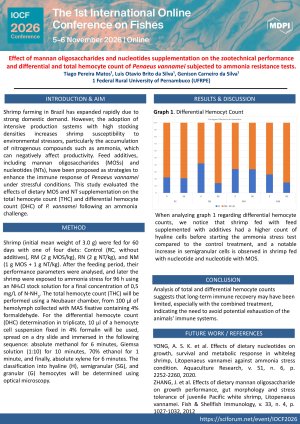
Shrimp farming in Brazil has expanded rapidly due to strong domestic demand. However, the adoption of intensive production systems with high stocking densities increases shrimp susceptibility to environmental stressors, particularly the accumulation of nitrogenous compounds such as ammonia, which can negatively affect productivity. Feed additives, including mannan oligosaccharides (MOSs) and nucleotides (NTs), have been proposed as strategies to enhance the immune response of Penaeus vannamei under stressful conditions. This study evaluated the effects of dietary MOS and NT supplementation on the total hemocyte count (THC) and differential hemocyte count (DHC) of P. vannamei following an ammonia challenge. Shrimp (initial mean weight of 3.0 g) were fed for 60 days with one of four diets: Control (RC, without additives), RM (2 g MOS/kg), RN (2 g NT/kg), and NM (1 g MOS + 1 g NT/kg). After the feeding period, their performance parameters were analysed, and later the shrimp were exposed to ammonia stress for 96 h using an NH₄Cl stock solution for a final concentration of 0,5 mg/L of N-NH3. The results showed that the animals fed with NM had the best FCR and the second best average final weight, whereas the MOS treatment showed the best survival rate. Increased THC was noted in shrimp fed RM and RN diets, whereas RC and NM treatments showed reduced hemocyte counts. DHC analysis indicated an improved immune response in shrimp receiving RN and NM diets, suggesting that MOSs and NTs, both individually and combined, contribute to mitigating the effects of ammonia-induced stress. These findings were further supported by survival rates. Nevertheless, the limited statistical differences among treatments indicated by the stress test show that the long-term recovery effects of these additives may be modest and warrant further investigation, although NM held the best performance before the stress test.
Keywords
Vannamei
Additive
Stress test
Hemocyte
Poster
Banner internacional final.pdf
Effects of dietary supplementation with piscidin 1 on the activity of digestive enzymes in gilthead seabream (Sparus aurata)
Elionurus muticus essential oil as a dietary additive improves productive performance and promotes metabolic homeostasis in Pangasius hypophthalmus