Event submissions
Published
This submission belongs to the session S2. Sustainable Fisheries and Aquaculture Innovations: Combating Overfishing and Advancing Aquatic Health of the event The 1st International Online Conference on Fishes
Published date
03 Nov, 2026
Academic Editor
 Wagner C. Valenti
Contribution&Funding
Conceptualization,
[Bianca Maciel Soares Pimenta Neves] ; [Alberto Teodorico Correia]
Methodology,
[Bianca Maciel Soares Pimenta Neves] ; [Alberto Teodorico Correia] ; [Agostinho Almiro Almeida] ; [Rui Azevedo] ; [Jorge Pisonero Castro] ; [Marcus Rodrigues Costa] ; [Rodolfo Miguel Almeida Silva] ; [Rafael Kulzer]
Validation,
[Rafael Kulzer] ; [Alberto Teodorico Correia] ; [Bianca Maciel Soares Pimenta Neves]
Formal analysis,
[Rafael Kulzer] ; [Alberto Teodorico Correia] ; [Bianca Maciel Soares Pimenta Neves]
Investigation,
[Rafael Kulzer] ; [Alberto Teodorico Correia] ; [Bianca Maciel Soares Pimenta Neves]
Resources,
[Jorge Pisonero Castro] ; [Marcus Rodrigues Costa] ; [Alberto Teodorico Correia]
Writing - original draft,
[Bianca Maciel Soares Pimenta Neves]
Writing - review,
[editing] ; [Jorge Pisonero Castro] ; [Agostinho Almiro Almeida] ; [Marcus Rodrigues Costa] ; [Rafael Kulzer] ; [Alberto Teodorico Correia]
Visualization,
[Bianca Maciel Soares Pimenta Neves] ; [Rafael Kulzer] ; [Alberto Teodorico Correia]
Supervision,
[Alberto Teodorico Correia]
Project administration,
[Alberto Teodorico Correia]
Funding acquisition,
[Alberto Teodorico Correia]
Funding: --
Citation
Bianca Maciel Soares Pimenta Neves, Rafael Kulzer, Rodolfo Miguel Almeida Silva, Felippe Alexandre Daros, Rafael Schroeder, Marcus Rodrigues Costa, Ana Méndez Vicente, Jorge Pisonero Castro, Rui Azevedo, Agostinho Almiro Almeida, Alberto Teodorico Correia, Integrating multi-temporal otolith elemental signatures reveals partial spatial structuring and connectivity in bluefish (Pomatomus saltatrix) along the Brazilian coast, in Proceedings of The 1st International Online Conference on Fishes, 5 November–6 November 2026, MDPI: Basel, Switzerland
Share
Email
Facebook
Twitter
LinkedIn
Integrating multi-temporal otolith elemental signatures reveals partial spatial structuring and connectivity in bluefish (Pomatomus saltatrix) along the Brazilian coast

Bianca Maciel Soares Pimenta Neves 1

Rafael Kulzer 1
Rodolfo Miguel Almeida Silva 2
Felippe Alexandre Daros 3
Rafael Schroeder 1
Marcus Rodrigues Costa 4
Ana Méndez Vicente 5
Jorge Pisonero Castro 6
Rui Azevedo 7

Agostinho Almiro Almeida 7

Alberto Teodorico Correia 2
1. Centro Interdisciplinar de Investigação Marinha e Ambiental, Universidade do Porto, Matosinhos, Portugal
2. Instituto de Ciências Biomédicas Abel Salazar, Universidade do Porto, 4050-313 Porto, Portugal
3. Faculdade de Ciências Agrárias do Vale do Ribeira, UNESP—Registro, Av. Nelson Brihi Badur 430, Registro 11900-000, Brazil
4. Universidade Federal Fluminense (UFF), Rua Professor Marcos Waldemar de Freitas Reis S/N, Campus do Gragoatá, Niterói 24210-201, Brazil
5. Scientific and Technological Resources, University of Oviedo, 33600 Mieres, Spain
6. Faculty of Science, University of Oviedo, 33600 Oviedo, Spain
7. LAQV REQUIMTE, Faculdade de Farmácia, Universidade do Porto, Rua de Jorge Viterbo Ferreira 228, 4050-313 Porto, Portugal
Abstract
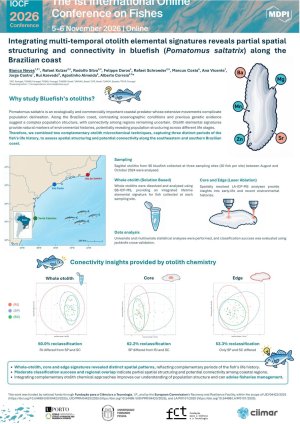
Understanding population structure and connectivity in highly mobile marine fishes is fundamental for effective fisheries management. Bluefish (Pomatomus saltatrix) is an ecologically and commercially important coastal pelagic species, yet its population structure along the southeastern–southern Brazilian coast remains poorly understood. This study investigated spatial population structuring by integrating otolith elemental signatures representing different periods of the species' life history. Sagittal otoliths from 90 bluefish collected in Rio de Janeiro, São Paulo, and Santa Catarina were analysed. Whole-otolith elemental signatures were quantified using solution-based inductively coupled plasma mass spectrometry (SB-ICP-MS), whereas core and edge element:Ca ratios were determined using laser ablation inductively coupled plasma mass spectrometry (LA-ICP-MS). These complementary approaches provided integrated lifetime, early-life, and recent environmental records. Spatial variation was assessed using univariate and multivariate statistical analyses, including flexible discriminant analysis. Significant spatial variation was detected in whole-otolith, core, and edge elemental signatures, although each analysis revealed a distinct geographical pattern. Whole-otolith signatures primarily differentiated Rio de Janeiro from São Paulo and Santa Catarina, whereas core signatures distinguished São Paulo from the remaining regions and edge signatures separated only São Paulo and Santa Catarina. Flexible discriminant analysis showed moderate classification success (53–62%) and considerable overlap among sampling regions, indicating incomplete spatial differentiation. The contrasting elemental signatures recorded in different otolith regions demonstrate that each approach captured complementary environmental information reflecting different stages of the life history. Integrating whole-otolith, core, and edge elemental signatures provided a more comprehensive assessment of population structure than any individual approach alone. The results support partial spatial structuring and connectivity among P. saltatrix populations along the southeastern–southern Brazilian coast, highlighting the value of multi-temporal otolith chemistry for investigating population connectivity and providing information relevant for stock assessment and spatial fisheries management.
Keywords
Natural Tags; LA-ICP-MS; SB-ICP-MS; Population Structure; Fisheries Management
Poster
Poster_Neves_IOCF_2026.pdf
Elionurus muticus essential oil as a dietary additive improves productive performance and promotes metabolic homeostasis in Pangasius hypophthalmus
Spatio-Temporal Dynamics of Freshwater Fish Assemblages and Catch Dynamics in Wular Lake, Kashmir Himalaya, India