Event submissions
Published
This submission belongs to the session S1. Climate Change Impact and Marine Pollution of the event The 1st International Online Conference on Fishes
Published date
03 Nov, 2026
Academic Editor
 Pedro Morais
Contribution&Funding
Conceptualization,
[Giulia Zeri] ; [Joana Cruz]
Methodology,
[Giulia Zeri] ; [Joana Cruz]
Formal analysis,
[Giulia Zeri]
Investigation,
[Vânia Baptista] ; [Maria Teodosio] ; [Joana Cruz]
Data curation,
[Giulia Zeri]
Writing - original draft,
[Giulia Zeri]
Writing - review,
[editing] ; [Vânia Baptista] ; [Maria Teodosio] ; [Joana Cruz]
Supervision,
[Joana Cruz]
Funding acquisition,
[Maria Teodosio] ; [Joana Cruz]
Funding: This study received Portuguese national funds from FCT - Foundation for Science and Technology through contracts UID/04326/2025 (DOI https://doi.org/10.54499/UID/04326/2025), UID/PRR/04326/2025 (DOI https://doi.org/10.54499/UID/PRR/04326/2025) and LA/P/01
Citation
Giulia Zeri, Vânia Baptista, Maria Teodosio, Joana Cruz, Anthropogenic particle ingestion by meroplanktonic fish larvae across the Guadiana estuary and Ria Formosa lagoon (South of Portugal)., in Proceedings of The 1st International Online Conference on Fishes, 5 November–6 November 2026, MDPI: Basel, Switzerland
Share
Email
Facebook
Twitter
LinkedIn
Anthropogenic particle ingestion by meroplanktonic fish larvae across the Guadiana estuary and Ria Formosa lagoon (South of Portugal).

Giulia Zeri 1,2

Vânia Baptista 1

Maria Teodosio 1

Joana Cruz 1
1. Algarve Centre of Marine Sciences - CCMAR, University of Algarve , Faro, 8005-139 , Portugal
2. IMBRSea, Ghent University, Ghent, 9000, Belgium
Abstract
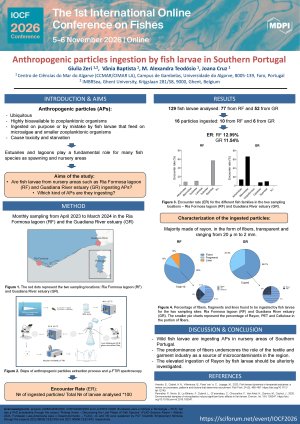
Before settling into adult benthic or pelagic habitats, fish spend their larval phase in the meroplankton. Like the rest of the zooplanktonic organisms, they are at the base of the food web and can therefore act as entry points for pollutants. Anthropogenic particles (APs), including microplastics, are ubiquitous and can bioaccumulate and biomagnify, causing adverse physiological effects on this fragile life stage and higher trophic levels. In this study, we investigated the ingestion of APs in wild fish larvae from two coastal ecosystems of the southern Portuguese Coast: the Guadiana River estuary and the Ria Formosa lagoon, sampled between April 2023 and March 2024. Of the 129 larvae, belonging to six different families and one order: Gobiidae (57.4%), Atherinidae (14.7%), Sparidae (13.2%), Blenniidae (6.2%), Clupeiformes (2.3%), Soleidae (1.6%) and Labridae (0.8%), a total of 16 particles were recovered, classified and then analysed using a μ-FTIR. The particles ranged from 20 μm to 2 mm; they were mainly fibres, transparent and made of rayon. The Encounter Rate (ER = [Total ingested particles / Total organisms analyzed] 100) varied between 0% and 66.7% across taxa, though no statistically significant differences were observed between taxonomic groups or sampling locations. Consistent with findings across other European coastal waters, these results confirm that fish larvae actively ingest particles of anthropogenic origin in natural habitats. This highlights the critical role of nursery grounds as microplastic exposure hotspots.
Keywords
Microplastic
Anthropogenic fibres
Fish larvae
Nursery areas
μ-FTIR
Coastal ecosystems
Poster
Poster IOCF_GZ.pdf
Spatio-Temporal Dynamics of Freshwater Fish Assemblages and Catch Dynamics in Wular Lake, Kashmir Himalaya, India
Fishing Area Rotativity and Recovery Time in the Estuarine Green Crab Fishery