Event submissions
Published
This submission belongs to the session S2. Sustainable Fisheries and Aquaculture Innovations: Combating Overfishing and Advancing Aquatic Health of the event The 1st International Online Conference on Fishes
Published date
03 Nov, 2026
Academic Editor
 Maria Angeles Esteban
Contribution&Funding
Conceptualization,
[Shinthuja Nadarajah]
Methodology,
[Shinthuja Nadarajah]
Validation,
[Shinthuja Nadarajah]
Formal analysis,
[Shinthuja Nadarajah]
Investigation,
[Shinthuja Nadarajah]
Resources,
[Shinthuja Nadarajah]
Data curation,
[Shinthuja Nadarajah]
Writing - original draft,
[Shinthuja Nadarajah]
Writing - review,
[editing] ; [Shinthuja Nadarajah]
Visualization,
[Shinthuja Nadarajah]
Supervision,
[Muthuladchumy Vinobaba]
Project administration,
[Muthuladchumy Vinobaba]
Funding: --
Citation
Shinthuja Nadarajah, Muthuladchumy Vinobaba, Effect of Black Soldier Fly Larvae meal for partial fishmeal replacement on growth performance of ornamental Molly fish (Poecilia sphenops), in Proceedings of The 1st International Online Conference on Fishes, 5 November–6 November 2026, MDPI: Basel, Switzerland
Share
Email
Facebook
Twitter
LinkedIn
Effect of Black Soldier Fly Larvae meal for partial fishmeal replacement on growth performance of ornamental Molly fish (Poecilia sphenops)

Shinthuja Nadarajah 1
Muthuladchumy Vinobaba 1
1. Department of Zoology, Faculty of Science, Eastern University, Vantharumoolai, Chenkalady, Sri Lanka
Abstract
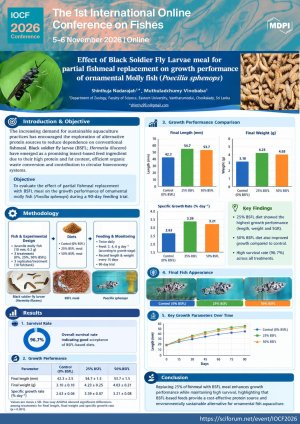
The increasing demand for sustainable aquaculture practices has encouraged the exploration of alternative protein sources to reduce dependence on conventional fishmeal. Black soldier fly larvae (BSFL; Hermetia illucens) have emerged as a promising insect-based feed ingredient due to their high protein and fat content, efficient organic waste conversion and contribution to circular bioeconomy systems. This study evaluated the effect of partial fishmeal replacement with BSFL meal on the growth performance of ornamental molly fish (Poecilia sphenops) during a 90-day feeding trial. Juvenile molly fish (initial length: 10 mm; initial weight: 0.2 g) were randomly assigned to three dietary treatments: 0% BSFL meal (control), 25% BSFL meal and 50% BSFL meal replacement. Each treatment consisted of three replicate tanks containing 10 fish per tank. Fish were fed twice daily, with feed quantities adjusted according to growth stage (2, 4, and 6 g day⁻¹). Body length and weight were recorded at 15-day intervals. The overall survival rate was 96.7%, indicating good acceptance of BSFL-based diets. At the end of the trial, fish fed the control diet recorded an average length of 42.3 ± 2.5 mm and weight of 3.10 ± 0.10 g. Fish fed the 25% BSFL diet achieved higher growth (54.7 ± 1.5 mm; 4.23 ± 0.25 g), followed by the 50% BSFL diet (53.7 ± 1.5 mm; 4.03 ± 0.21 g). One-way ANOVA revealed significant differences among treatments in final length, final weight and specific growth rate (p < 0.001). The 25% BSFL treatment recorded the highest specific growth rate (3.39 ± 0.07% day⁻¹). These findings demonstrate that replacing 25% of fishmeal with BSFL meal enhances growth performance while maintaining high survival, highlighting that BSFL-based feeds provide a cost-effective protein source and environmentally sustainable alternative for ornamental fish aquaculture.
Keywords
Black soldier fly larvae fishmeal
ornamental fish
aquaculture
growth performance
sustainable
Poster
Sciforum-207427 Poster.pdf
Habitat Suitability Modeling for the Hill-Stream Loach Triplophysa kashmirensis (Hora, 1925): Identifying Optimal Environmental Conditions and Conservation Priorities in the Kashmir Himalaya
Valorization of onion peel waste as a sustainable feed additive to improve resource efficiency, foster climate resilient ecosystems, and enhance growth and metabolic health parameters in Labeo rohita