Event submissions
Published
This submission belongs to the session S2. Sustainable Fisheries and Aquaculture Innovations: Combating Overfishing and Advancing Aquatic Health of the event The 1st International Online Conference on Fishes
Published date
03 Nov, 2026
Academic Editor
 Wagner C. Valenti
Citation
Rubab Fatima, Kifayat Ullah Khan, Fatima Noor-ul-Ain Afreen, Pakeeza Zainab, Yasir Hameed, Valorization of onion peel waste as a sustainable feed additive to improve resource efficiency, foster climate resilient ecosystems, and enhance growth and metabolic health parameters in Labeo rohita , in Proceedings of The 1st International Online Conference on Fishes, 5 November–6 November 2026, MDPI: Basel, Switzerland
Share
Email
Facebook
Twitter
LinkedIn
Valorization of onion peel waste as a sustainable feed additive to improve resource efficiency, foster climate resilient ecosystems, and enhance growth and metabolic health parameters in Labeo rohita

Rubab Fatima 1
Kifayat Ullah Khan 1
Fatima Noor-ul-Ain Afreen 1
Pakeeza Zainab 1
Yasir Hameed 1
1. Department of Zoology, Government College University, Lahore, 54000, Pakistan
Abstract
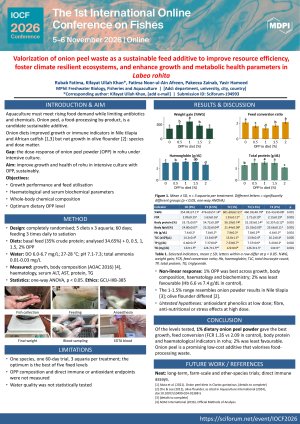
Introduction: Rich in bioactive compounds, onion peels are a major agro-industrial waste concern. Valorizing these by-products is essential to transform agricultural waste into sustainable, eco-friendly, and cost-effective products. Therefore, this research was conducted to analyze the impact of onion peel powder (OPP) on growth rate, nutritional value, and hemato-biochemical parameters in juvenile rohu (Labeo rohita). Methods: A completely randomized design consisting of five treatment groups and three replicates per group was used. Fifteen fish of 4.12 ± 0.27 g (initial average weight) were stocked per fiberglass tank of 150-L. The control group was fed a diet without onion peel powder (0.00% OPP), whereas the four supplemented groups were fed diets containing OPP at 0.5%, 1.0%, 1.5%, and 2.0%, respectively. Feeding for 60 days (three times per day) was manually done until apparent satiation. A one-way analysis of variance was performed to evaluate the data, and means were compared using Tukey's LSD test in Statistix (version 9.0). Results: Statistical analysis showed that the diet supplemented with 01% OPP significantly improved (p < 0.05) growth performance (weight gain, specific growth rate and feed conversion ratio) and physiological and metabolic health markers (blood profile and whole-body nutritional composition) of fish. Dietary OPP exceeding 01% induced deleterious effects, thereby impairing fish growth and health aspects. Conclusions: These results show that incorporating an optimum level of onion peel powder into rohu diet may contribute to improving growth, nutritional quality and metabolic health parameters in rohu, with reducing waste produced from the agriculture/food sector. This study provides aquaculturists with important strategies for incorporating agricultural byproducts into aquafeed, thereby advancing food security with promoting climate resilient ecosystem, optimizing resource efficiency, and overall aquaculture sustainability.
Keywords
Agro-waste management
Allium cepa
Climate-resilient ecosystems
Functional feed
Sustainable aquaculture
Poster
DOC-20261102-WA0012.pdf
Effect of Black Soldier Fly Larvae meal for partial fishmeal replacement on growth performance of ornamental Molly fish (Poecilia sphenops)
From Aeromonas diversity to genome architecture: genomic characterization of an Aeromonas isolate associated with an endangered freshwater fish