Event submissions
Published
This submission belongs to the session S3. Genetics and Genomics of the event The 1st International Online Conference on Fishes
Published date
03 Nov, 2026
Academic Editor
 Eric Hallerman
Citation
Syeda Maira Hamid, Maaz Waseem, Mian Muhammad Ahmed, Nie Zhulan, From Aeromonas diversity to genome architecture: genomic characterization of an Aeromonas isolate associated with an endangered freshwater fish, in Proceedings of The 1st International Online Conference on Fishes, 5 November–6 November 2026, MDPI: Basel, Switzerland
Share
Email
Facebook
Twitter
LinkedIn
From Aeromonas diversity to genome architecture: genomic characterization of an Aeromonas isolate associated with an endangered freshwater fish

Syeda Maira Hamid 1,2
Maaz Waseem 3
Mian Muhammad Ahmed 1
Nie Zhulan 1,2
1. College of Life Science and Technology, Tarim University, Alar 843300, China
2. Xinjiang Production & Construction Corps Key Laboratory of Protection and Utilization of Biological Resources in Tarim Basin, Alar 843300, China
3. Atta-ur-Rahman school of Applied Biosciences (ASAB), National University of Science and Technology (NUST), Islamabad, Pakistan
Abstract
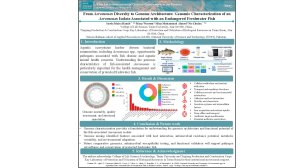
Aquatic ecosystems harbor diverse bacterial communities, among which Aeromonas spp. are recognized as important opportunistic pathogens affecting fish health and conservation efforts. Previous investigations have revealed substantial diversity in antimicrobial resistance and virulence profiles among Aeromonas isolates associated with endangered freshwater fishes; however, the genomic mechanisms underlying pathogenicity, environmental persistence, and adaptation remain insufficiently understood. This study aimed to investigate the genome-level characteristics of an Aeromonas veronii isolate associated with an endangered Schizothoracine freshwater fish, scaly osman Diptychus maculatus, from Xinjiang, China, and provide insights into its adaptive and pathogenic potential. A representative pathogenic Aeromonas isolate was subjected to hybrid whole-genome sequencing integrating short- and long-read sequencing technologies. Genome assembly, quality assessment, and structural annotation were performed, followed by comprehensive functional characterization using genomic databases, including NR, COG, KEGG, GO, Pfam, Swiss-Prot, VFDB, and PHI-base. Genome mining approaches were applied to identify genetic features associated with virulence, antimicrobial resistance potential, metabolic functions, and environmental adaptation. Genome analysis revealed a complex genetic repertoire associated with bacterial survival, host interaction, and ecological adaptation. Functional annotation identified diverse biological pathways supporting metabolic versatility, while genomic screening highlighted signatures linked with pathogenic potential and evolutionary flexibility. These findings provide insights into the genetic basis supporting the persistence of Aeromonas veronii within aquatic environments. This genome-based investigation enhances understanding of Aeromonas adaptation in endangered fish-associated ecosystems and highlights the importance of genomic approaches for pathogen surveillance, biodiversity conservation, and sustainable aquatic health management.
Keywords
Aeromonas spp.
whole-genome sequencing
aquatic pathogen
endangered fish
genome evolution
genomic surveillance
Poster
Sciforum-206527 Poster presentation.pdf
Valorization of onion peel waste as a sustainable feed additive to improve resource efficiency, foster climate resilient ecosystems, and enhance growth and metabolic health parameters in Labeo rohita
Macrobenthic assemblages and its relationship with water and sediment quality in estuarine ecosystem of Sandwip Island, Bangladesh