Event submissions
Published
This submission belongs to the session S1. Climate Change Impact and Marine Pollution of the event The 1st International Online Conference on Fishes
Published date
03 Nov, 2026
Academic Editor
 Pedro Morais
Citation
Gaia Zamengo, Joana Cruz, Dara Aline, Vânia Baptista, Maria Alexandra Teodósio, Hugulay Maia, Ingestion of Anthropogenic Particles by Early Life Stages of Amphidromous Gobies in São Tomé Island, in Proceedings of The 1st International Online Conference on Fishes, 5 November–6 November 2026, MDPI: Basel, Switzerland
Share
Email
Facebook
Twitter
LinkedIn
Ingestion of Anthropogenic Particles by Early Life Stages of Amphidromous Gobies in São Tomé Island

Gaia Zamengo 1,2

Joana Cruz 1
Dara Aline 1,3

Vânia Baptista 1

Maria Alexandra Teodósio 1
Hugulay Maia 4
1. Centre of Marine Sciences of the Algarve (CCMAR/CIMAR-LA), Campus de Gambelas, University of Algarve, Faro, 8005-139, Portugal
2. Department of Biology, University of Padova, Padova, 35121 , Italy
3. State University of Amapá (UEAP), Macapá, -, Brazil
4. Department of Natural, Life and Environmental Sciences, University of São Tomé and Príncipe, São Tomé, São Tomé and Príncipe
Abstract
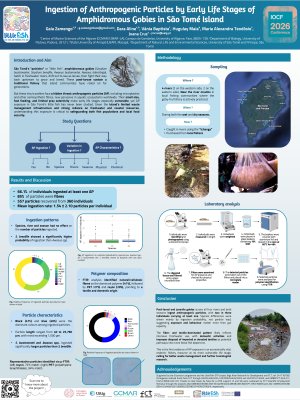
Amphidromous gobies support the traditional "peixinho" fishery in São Tomé and Príncipe, playing a key role in local food security. However, the exposure of their early life stages to anthropogenic particles (AP), including microplastics and textile-derived fibres, now common in aquatic environments, has never been assessed.
This study provides the first quantification of AP ingestion in post-larval and juvenile gobies (Sicydium bustamantei, S. brevifile, and Awaous spp.) collected from four rivers during the wet and dry seasons. A total of 360 individuals were digested using 10% KOH, and recovered particles were visually classified by shape, size, and colour. A subset was further analysed for polymer composition using Fourier-transform infrared spectroscopy (FTIR), and ingestion patterns were analysed using hurdle models to account for zero inflation.
Anthropogenic particles were detected in 66.1% of individuals (557 particles recovered; mean 1.54 ± 2.10 particles/individual). Species, river, and season did not significantly affect particle counts, but S. brevifile showed a higher probability of ingestion than Awaous spp. Fibres dominated (85%), mostly black and blue, ranging from 40 µm to 2.6 cm. Despite being the largest species, S. brevifile ingested significantly smaller particles than S. bustamantei and Awaous spp., suggesting that exposure is driven by feeding behaviour rather than body size. FTIR confirmed a predominance of cellulosic fibres, pointing to domestic and textile-related sources.
These findings reveal widespread AP exposure in early goby life stages and underline the urgent need for improved waste management and further toxicological research to safeguard fish populations and food security in São Tomé and Príncipe.
Keywords
Pollution
Microplastics
Sicydium bustamantei
Sicydium brevifile
Awaous
Poster
PosterIOCFGaiaZamengo.pdf
Macrobenthic assemblages and its relationship with water and sediment quality in estuarine ecosystem of Sandwip Island, Bangladesh
HASTE MAKES WASTE: ACCELERATED MATURATION AND PRECOCIOUS OOCYTE ATRESIA IN Astyanax lacustris (CHARACIFORMES, CHARACIDAE)