Event submissions
Published
This submission belongs to the session S1. Climate Change Impact and Marine Pollution of the event The 1st International Online Conference on Fishes
Published date
03 Nov, 2026
Academic Editor
 Pedro Morais
Citation
Amanda Satomi Tatibana, Beatriz Santos Lopes, Cristieli Fernanda Belancieri Souza, Alexandre Ninhaus-Silveira, Rosicleire Veríssimo-Silveira, HASTE MAKES WASTE: ACCELERATED MATURATION AND PRECOCIOUS OOCYTE ATRESIA IN Astyanax lacustris (CHARACIFORMES, CHARACIDAE), in Proceedings of The 1st International Online Conference on Fishes, 5 November–6 November 2026, MDPI: Basel, Switzerland
Share
Email
Facebook
Twitter
LinkedIn
HASTE MAKES WASTE: ACCELERATED MATURATION AND PRECOCIOUS OOCYTE ATRESIA IN Astyanax lacustris (CHARACIFORMES, CHARACIDAE)

Amanda Satomi Tatibana 1
Beatriz Santos Lopes 1
Cristieli Fernanda Belancieri Souza 1
Alexandre Ninhaus-Silveira 1
Rosicleire Veríssimo-Silveira 1
1. Neotropical Ichthyology Laboratory (LINEO), School of Engineering, São Paulo State University “Júlio de Mesquita Filho” (UNESP), Ilha Solteira Campus, São Paulo, Brazil.
Abstract
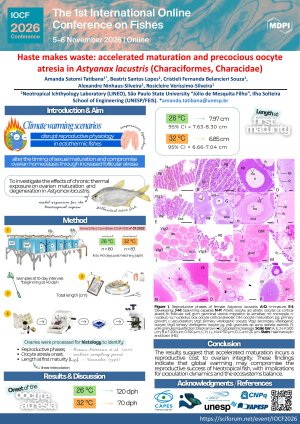
Introduction: Rising temperatures disrupt reproductive physiology in ectothermic fishes, whose gonadal development is temperature-dependent. Under climate warming scenarios, prolonged exposure to elevated temperatures may alter the timing of sexual maturation and compromise ovarian homeostasis through increased follicular atresia. Despite growing evidence of thermal effects on fish reproduction, the relationship between accelerated maturation and ovarian degeneration remains unclear in Neotropical freshwater species. Therefore, this study investigated the effects of chronic thermal exposure on sexual maturation and oocyte atresia in Astyanax lacustris. Methods: Female Astyanax lacustris were reared at 26 ºC (n = 80, control) or 32 ºC (n = 83, treatment) from 16 to 140 days post-hatching (dph) and sampled at 10-day intervals beginning at 40 dph. Ovaries were processed for histology to identify reproductive phases, oocyte atresia onset, and length at first maturity (L50), estimated by binomial logistic regression. Atresia onset was compared between groups based on the earliest sampling point at which atretic follicles were histologically confirmed. Results: Females at 26 ºC exhibited an estimated L50 of 7.97 cm (95% CI = 7.63-8.30 cm), whereas those exposed to 32 ºC reached first maturity at a smaller size (6.85 cm; 95% CI = 6.66-7.04 cm); non-overlapping 95% CIs indicated that females at 32 ºC matured at a smaller size. Although the precise onset of oocyte atresia could not be determined, because of the sampling intervals, it was first detected at 120 dph in the control group, compared to 70 dph in the treatment group. Conclusion: Prolonged exposure to elevated temperature accelerated reproductive maturation in female Astyanax lacustris, reducing size at first maturity, but was associated with precocious oocyte atresia, suggesting that accelerated maturation incurs a reproductive cost to ovarian integrity. These findings indicate that climate warming may compromise the reproductive success of Neotropical fish, with implications for population dynamics.
Keywords
Atresia
Climate change
Sexual maturation
Neotropical fish.
Poster
Pôster IOCF 2026 - Amanda Satomi Tatibana 09.10.pdf
Ingestion of Anthropogenic Particles by Early Life Stages of Amphidromous Gobies in São Tomé Island
Structural Transformation and Economic Resilience in Madeira Island’s Fisheries Sector