Event submissions
Published
This submission belongs to the session S2. Sustainable Fisheries and Aquaculture Innovations: Combating Overfishing and Advancing Aquatic Health of the event The 1st International Online Conference on Fishes
Published date
03 Nov, 2026
Academic Editor
 Wagner C. Valenti
Citation
Magnolia Montoya-Mejia, Carlos Alberto Soto-Robles, Edén Vladimir Gaitán-Morado, María Sarahi Ruiz-Lugo, Jesus Lucina Romero-Romero, Andrés Martín Góngora-Gómez, Héctor Abelardo González-Ocampo, Antimicrobial activity of plant-mediated zinc oxide nanoparticles against Streptococcus agalactiae and Aeromonas spp. isolated from tilapia, in Proceedings of The 1st International Online Conference on Fishes, 5 November–6 November 2026, MDPI: Basel, Switzerland
Share
Email
Facebook
Twitter
LinkedIn
Antimicrobial activity of plant-mediated zinc oxide nanoparticles against Streptococcus agalactiae and Aeromonas spp. isolated from tilapia

Magnolia Montoya-Mejia 1

Carlos Alberto Soto-Robles 2
Edén Vladimir Gaitán-Morado 3
María Sarahi Ruiz-Lugo 4
Jesus Lucina Romero-Romero 1
Andrés Martín Góngora-Gómez 1
Héctor Abelardo González-Ocampo 1
1. CIIDIR Sinaloa Unit, Interdisciplinary Research Centre for Integral Regional Development, Instituto Politécnico Nacional, Guasave, Sinaloa 81101, Mexico
2. Los Altos University Center, University of Guadalajara, Tepatitlán de Morelos, Jalisco 47620, Mexico
3. Faculty of Biology, Universidad Michoacana de San Nicolás de Hidalgo, Morelia, Michoacán 58030, Mexico
4. Department of Chemical and Biochemical Engineering, Los Mochis Campus, Tecnológico Nacional de México / Instituto Tecnológico de Los Mochis, Los Mochis, Sinaloa 81259, Mexico
Abstract
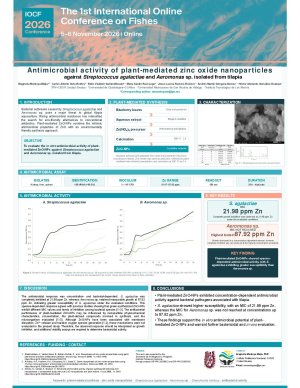
Bacterial outbreaks caused by Streptococcus agalactiae and Aeromonas spp. pose a major threat to global tilapia (Oreochromis niloticus) aquaculture. Rising antimicrobial resistance has intensified the search for eco-friendly alternatives to conventional antibiotics, including nanotechnology-based strategies for sustainable health management.
This study investigated the antimicrobial activity of plant-mediated zinc oxide nanoparticles (ZnO-NPs) against bacterial pathogens isolated from diseased tilapia. The ZnO-NPs were synthesized using a plant-mediated wet-chemical precipitation method with aqueous blueberry (Vaccinium corymbosum) leaf extract as a biogenic stabilizer and zinc nitrate as a precursor, followed by calcination to obtain crystalline ZnO-NPs. The aqueous plant extract was used as a source of biogenic compounds during nanoparticle formation and stabilization.
Bacterial strains were isolated from kidney, liver, and spleen samples and identified by 16S rRNA gene sequencing (>99.5% sequence identity). Antibacterial activity was evaluated through broth microdilution assays in tryptic soy broth and growth kinetics monitored at 580 nm, with Zn concentrations ranging from 0.117 to 87.92 ppm.
Results revealed a concentration-dependent inhibitory effect. S. agalactiae was highly susceptible, with a minimum inhibitory concentration (MIC) of 21.98 ppm, whereas Aeromonas spp. required higher concentrations for significant growth suppression, indicating differential susceptibility between the evaluated bacterial pathogens. Growth kinetics confirmed reduced bacterial proliferation in the presence of plant-mediated ZnO-NPs.
Overall, these findings highlight the in vitro antimicrobial potential of plant-mediated ZnO-NPs and support their further evaluation as candidates for sustainable bacterial disease management in tilapia aquaculture, with potential application as a nanotechnology-based strategy to reduce reliance on conventional antibiotics.
Keywords
Oreochromis niloticus
Plant-mediated synthesis
Zinc oxide nanoparticles
Streptococcus agalactiae
Aeromonas spp.
Antibacterial activity
Poster
poster mmm.pdf
Structural Transformation and Economic Resilience in Madeira Island’s Fisheries Sector
Enhancing Labeo rohita production with propolis: A natural immunostimulant for sustainable aquaculture