Event submissions
Published
This submission belongs to the session S2. Sustainable Fisheries and Aquaculture Innovations: Combating Overfishing and Advancing Aquatic Health of the event The 1st International Online Conference on Fishes
Published date
03 Nov, 2026
Academic Editor
 Wagner C. Valenti
Citation
Yasir Hameed, Kifayat Ullah Khan, Pakeeza Zainab, Fatima Noor-ul-Ain Afreen, Rubab Fatima, Hamna Naveed Cheema, Muhammad Muddassar Iqbal, Towards green aquaculture: Withania coagulans as a natural feed additive for sustainable and healthier production of Ctenopharyngodon Idella, in Proceedings of The 1st International Online Conference on Fishes, 5 November–6 November 2026, MDPI: Basel, Switzerland
Share
Email
Facebook
Twitter
LinkedIn
Towards green aquaculture: Withania coagulans as a natural feed additive for sustainable and healthier production of Ctenopharyngodon Idella

Yasir Hameed 1
Kifayat Ullah Khan 1
Pakeeza Zainab 1
Fatima Noor-ul-Ain Afreen 1
Rubab Fatima 1
Hamna Naveed Cheema 1
Muhammad Muddassar Iqbal 1
1. Department of Zoology, Government College University, Lahore, 54000, Pakistan
Abstract
Introduction: Incorporating natural immunostimulants into aquafeed provides is an eco-friendly approach to ensure sustainable and healthier aquaculture production. Methods: Two feeding trials (initial weight: 4.21 ± 0.51 g for 42 days and 4.10 ± 0.63 g for 84 days) were conducted to evaluate the effects of dietary supplementation of Withania coagulans on growth performance and health status in juvenile grass carp (Ctenopharyngodon idella). Fish were divided into groups and fed either on a control diet (0% W. coagulans) or diets supplemented with increasing levels of W. coagulans (0.5%, 01%, 1.5%, 02%, and 2.5%) three times a day until apparent satiation. Statistical differences (p < .05) among experimental groups were assessed by one-way ANOVA followed by Tukey’s LSD test. Quadratic regression was done to determine the optimal concentration of the feed additive. Results: Results obtained from both trials showed that the optimal dietary supplementation of W. coagulans significantly improved (p < 0.05) growth and metabolic efficiency in C. idella. The optimal inclusion levels were determined to be 2.08% for a short term (42 days) feeding and 1.3% for a long term (84 days) feeding by using the quadratic regression analysis. The supplementation beyond optimal level in the long term feeding trial showed negative effects on growth and health parameters, revealing that intake of the test nutrient at higher concentrations for prolonged periods may restrict feed intake and growth in grass carp and induce oxidative stress. Conclusions: The optimal dietary supplementation of W. coagulans significantly improved growth and health in juvenile grass carp during both feeding trials. However, excessive dietary inclusion for prolonged periods compromised these benefits, possibly due to the adverse effects of antinutritional factors and secondary metabolites. Further research is recommended to determine the optimal inclusion of W. coagulans for large-size grass carp and other high-value species.
Keywords
Green aquaculture
Metabolic regulation
Performance enhancement
Sustainable grass carp farming
Withania coagulans
Poster
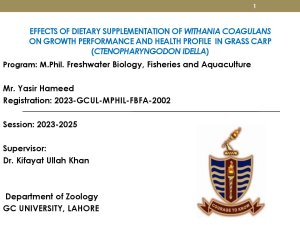
Yasir_M.Phil. Presentation.pdf
Enhancing Labeo rohita production with propolis: A natural immunostimulant for sustainable aquaculture
Biomarker Signatures for Detecting Chemical-Induced Developmental Delays in Zebrafish Embryo Model