Event submissions
Published
This submission belongs to the session S2. Sustainable Fisheries and Aquaculture Innovations: Combating Overfishing and Advancing Aquatic Health of the event The 1st International Online Conference on Fishes
Published date
03 Nov, 2026
Academic Editor
 Maria Angeles Esteban
Citation
Gloria Chidiebere Ajugwo, Emmanuel Ogwu Chukwu, Vanessa Saalmann, Bingxu Chen, Stefan Scholz, Biomarker Signatures for Detecting Chemical-Induced Developmental Delays in Zebrafish Embryo Model, in Proceedings of The 1st International Online Conference on Fishes, 5 November–6 November 2026, MDPI: Basel, Switzerland
Share
Email
Facebook
Twitter
LinkedIn
Biomarker Signatures for Detecting Chemical-Induced Developmental Delays in Zebrafish Embryo Model

Gloria Chidiebere Ajugwo 1
Emmanuel Ogwu Chukwu 1
Vanessa Saalmann 1
Bingxu Chen 1
Stefan Scholz 1
1. Ecotoxicology Department, Helmholtz Centre for Environmental Research, UFZ, Leipzig, Germany.
Abstract
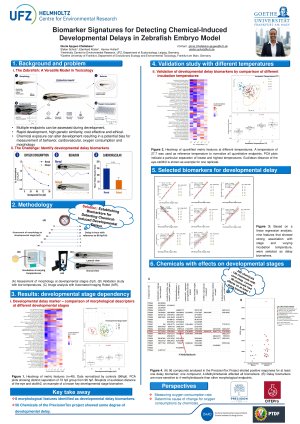
Chemicals can disrupt normal embryonic development, resulting in embryo toxicity, developmental delay or abnormal development. Detecting developmental toxicity is critical for both humans and the environment. Zebrafish embryos are widely used in developmental toxicology, supported by advances in automated image-based assessment of structural features. To improve chemical comparison and link effects to mechanisms of toxicity, identifying biomarkers for developmental delay is crucial. To establish morphological markers for developmental delay in zebrafish embryos at the 96 hours post-fertilisation (hpf) reference stage, we quantitatively characterised the morphological progression from 72 to 96 hpf using the Automated Imaging Robot (AIR). Features were quantified using FishInspector software and analysed with KNIME workflows and R scripts. For validation, embryos were incubated at different temperatures (24.5–27.7°C) and compared with structural features at 96 hpf. Using regression analysis, structural features with stage and temperature dependency were identified. An existing dataset of ~200 chemicals (PrecisionTox project) with quantitative morphological effect data was used to identify compounds primarily causing developmental delay. The stage and temperature dependency of 48 structural features were evaluated with heatmaps and principal component analysis. Seventeen of these features strongly correlated (r² > 0.8) with developmental progression. Of these, nine also showed strong temperature dependency and were selected as robust biomarkers of delayed development. A total of 56 chemicals from PrecisionTox showed effects on one or more of the nine biomarkers, with 4-methylimidazole having effects and greater sensitivity on all nine biomarkers (median EC50=6,206µM) than other morphological features (median EC50=12,849µM). This indicates that developmental delay was the primary effect. At higher concentrations, other structural features unrelated to developmental delay, like notochord curvature, were identified. The established developmental delay biomarkers could provide mechanistic links to modes of action, distinguishing compounds that primarily slow development from those causing other developmental effects. They can aid in prioritising chemicals with potential developmental toxicity relevant to environmental and human health.
Keywords
Zebrafish
developmental delay
biomarkers
chemical screening
developmental toxicity
Poster
Gloria_Ajugwo_1st Int. Conf_poster2.pdf
Towards green aquaculture: Withania coagulans as a natural feed additive for sustainable and healthier production of Ctenopharyngodon Idella
Stock Assessment of the Scylla serrata (Giant mud crab) in Achchankulam Lagoon, Sri Lanka