Event submissions
Published
This submission belongs to the session S2. Sustainable Fisheries and Aquaculture Innovations: Combating Overfishing and Advancing Aquatic Health of the event The 1st International Online Conference on Fishes
Published date
03 Nov, 2026
Academic Editor
 Wagner C. Valenti
Citation
Sripathmarasa Thivviyan, Nadarajah Ragavan, Dadigamuwage Chamari Tathsaramala Dissanayake, Stock Assessment of the Scylla serrata (Giant mud crab) in Achchankulam Lagoon, Sri Lanka, in Proceedings of The 1st International Online Conference on Fishes, 5 November–6 November 2026, MDPI: Basel, Switzerland
Share
Email
Facebook
Twitter
LinkedIn
Stock Assessment of the Scylla serrata (Giant mud crab) in Achchankulam Lagoon, Sri Lanka

Sripathmarasa Thivviyan 1,2
Nadarajah Ragavan 2
Dadigamuwage Chamari Tathsaramala Dissanayake 1
1. Department of Zoology, University of Sri Jayewardenepura, Gangodawila, Nugegoda, Sri Lanka
2. Department of Fisheries, University of Jaffna, Jaffna, Sri Lanka
Abstract
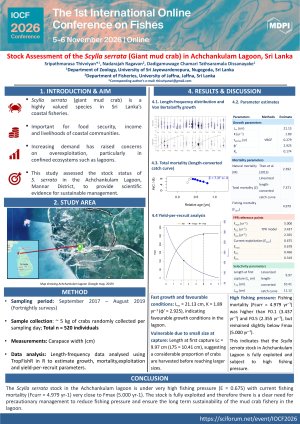
The Scylla serrata (Giant mud crab) is a highly valued species in Sri Lanka’s coastal fisheries due to its nutritional value and economic importance. In recent years, concerns have arisen regarding overexploitation and the sustainability of its stocks, particularly in confined ecosystems such as lagoons. This study assessed the stock status of Scylla serrata in the Achchankulam Lagoon, located in the Mannar District of Sri Lanka. Fortnightly field surveys were conducted at major landing sites from September 2017 to August 2019. On each sampling day, approximately 5 kg of crabs were randomly collected, and carapace width measurements were taken from a total of 520 individuals. Monthly length-frequency data were analyzed using the TropFishR package in R. The results showed that von Bertalanffy growth parameters estimated an asymptotic carapace width (L∞) of 21.13 cm and a growth coefficient (K) of 1.89 yr⁻¹. The anchor age at zero length (tanchor = 0.279 years) suggested that peak recruitment occurs around mid-April. The growth performance index (φ') was calculated as 2.925, indicating favorable growth conditions in the lagoon. The estimated natural mortality (M), fishing mortality (F), and total mortality (Z) were 2.392 yr⁻¹, 4.979 yr⁻¹, and 7.371 yr⁻¹, respectively. The current exploitation rate (E = 0.67) exceeded the precautionary limit of 0.5, suggesting that the stock is experiencing high fishing pressure. However, yield-per-recruit (YPR) analysis demonstrated that the current fishing effort (4.979 yr⁻¹) is approaching the maximum sustainable yield (Fmax), estimated at 5.000 yr⁻¹. These findings underscore the need for precautionary management to ensure the long-term sustainability of the Scylla serrata fishery in Achchankulam Lagoon.
Keywords
Population dynamics
Sustainability
Lagoon fishery
Overexploitation
Fishery management
Poster
Sciforum-194978_Thivviyan Poster.pdf
Biomarker Signatures for Detecting Chemical-Induced Developmental Delays in Zebrafish Embryo Model
Helminth Diversity in Freshwater Fish from Khun Thalae Swamp, Surat Thani Province, Thailand