Event submissions
Published
This submission belongs to the session S5. Biodiversity Protection: Conservation of Endangered Species and Control of Invasive Species of the event The 1st International Online Conference on Fishes
Published date
03 Nov, 2026
Academic Editor
 Maria Angeles Esteban
Citation
Srisupaph Poonlaphdecha, Kanda Kamchoo, Alexis RIBAS SALVADOR, Helminth Diversity in Freshwater Fish from Khun Thalae Swamp, Surat Thani Province, Thailand, in Proceedings of The 1st International Online Conference on Fishes, 5 November–6 November 2026, MDPI: Basel, Switzerland
Share
Email
Facebook
Twitter
LinkedIn
Helminth Diversity in Freshwater Fish from Khun Thalae Swamp, Surat Thani Province, Thailand

Srisupaph Poonlaphdecha 1
Kanda Kamchoo 2
Alexis RIBAS SALVADOR 3
1. Parasitology Section, Department of Biology, Healthcare and Environment, Faculty of Pharmacy and Food Science, Institut de Recerca de la Biodiversitat (IRBio), University of Barcelona, Barcelona, Spain
2. Faculty of Innovative Agriculture, Fisheries and Food, Prince of Songkla University, Surat Thani Campus, Surat Thani, Thailand
3. Parasitology Section, Department of Biology, Healthcare and Environment, Faculty of Pharmacy and Food Science, University of Barcelona, Spain
Abstract
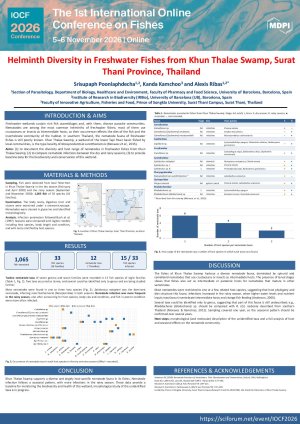
Freshwater wetlands are biodiversity hotspots that support complex ecological interactions, including diverse parasite communities that contribute to ecosystem functioning and food-web dynamics. Despite their ecological importance, helminth diversity in freshwater fish from southern Thailand remains poorly documented. This study investigates the diversity and seasonal occurrence of helminths infecting freshwater fish in Khun Thalae Swamp, Surat Thani Province, Thailand. Fish were randomly collected by local fishermen during the summer (February–April 2020) and rainy (September–November 2020) seasons. A total of 1,065 fish, representing a broad range of freshwater taxa, were examined using standard parasitological techniques. Helminths recovered from external and internal organs were identified to the lowest practical taxonomic level, and infection patterns were compared between seasons. Helminth infections were common in both sampling periods, with a higher prevalence observed during the rainy season. The parasite community comprised representatives of all major freshwater fish helminth groups, demonstrating considerable taxonomic diversity and a broad host range. Differences in infection patterns among fish hosts and between seasons suggest that environmental conditions and host ecology influence the structure of the parasite community within the wetland ecosystem. This study provides the first comprehensive assessment of helminth diversity in freshwater fish from Khun Thalae Swamp and establishes an important baseline for future ecological and biodiversity research in southern Thailand. The findings highlight the value of parasite diversity as an integral component of freshwater biodiversity and emphasize the importance of conserving wetland ecosystems that sustain both host and parasite communities.
Keywords
Freshwater wetlands
Helminth diversity
Freshwater fish
Parasite communities
Southern Thailand
Poster
poster_nematodes_KhunThalae_IOCF_02112026.pdf
Stock Assessment of the Scylla serrata (Giant mud crab) in Achchankulam Lagoon, Sri Lanka
Effect of Cymbopogon winterianus Essential Oil on Sedative and Anesthetic Induction Time in Bold and Shy Nile Tilapia