Event submissions
Published
This submission belongs to the session S4. Behavioral Ecology of Aquatic Animals: Implications for Habitat Conservation and Ecosystem Services of the event The 1st International Online Conference on Fishes
Published date
03 Nov, 2026
Academic Editor
 Maria Angeles Esteban
Citation
Bruno Mendes Visoni, Berta Maria Heinzmann, Mauro Alves Cunha, Matheus Dellaméa Baldissera, José Francisco Valério Júnior, Bernardo Baldisserotto, Effect of Cymbopogon winterianus Essential Oil on Sedative and Anesthetic Induction Time in Bold and Shy Nile Tilapia, in Proceedings of The 1st International Online Conference on Fishes, 5 November–6 November 2026, MDPI: Basel, Switzerland
Share
Email
Facebook
Twitter
LinkedIn
Effect of Cymbopogon winterianus Essential Oil on Sedative and Anesthetic Induction Time in Bold and Shy Nile Tilapia

Bruno Mendes Visoni 1
Berta Maria Heinzmann 2
Mauro Alves Cunha 3
Matheus Dellaméa Baldissera 4
José Francisco Valério Júnior 1

Bernardo Baldisserotto 3
1. Department of Animal Husbandry, Universidade Federal de Santa Maria (UFSM), Santa Maria 97105-900, Brazil
2. Department of Industrial Pharmacy, Universidade Federal de Santa Maria (UFSM), Santa Maria 97105-900, Brazil
3. Department of Physiology and Pharmacology, Universidade Federal de Santa Maria (UFSM), Santa Maria 97105-900, Brazil
4. Laboratory of Mycological Diseases, Universidade Franciscana, Santa Maria, 97010-032, Brazil
Abstract
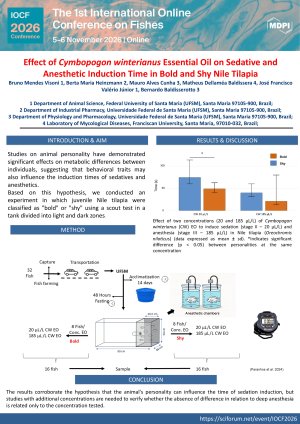
Studies on animal personality have demonstrated significant effects on metabolic differences between individuals, suggesting that behavioral traits may also influence the induction times of sedatives and anesthetics. Based on this hypothesis, we conducted an experiment in which juvenile Nile tilapia were classified as "bold" or "shy" using an exploration test in a tank divided into light and dark zones. The test consisted of placing 25 fasting juveniles (48 h) (38.13 ± 13.48 g) in the dark compartment, where they remained for 30 minutes for acclimatization. After the acclimatization period, commercial pellets were introduced into the lighted compartment for 40 minutes, providing both feeding and olfactory stimuli. Fish could move freely between compartments until the divider was closed. Individuals who remained in the dark compartment were classified as shy, while those present in the illuminated compartment were classified as bold. The procedure was repeated until 16 bold juveniles and 16 shy juveniles were obtained. Subsequently, the animals were subjected to sedation and anesthesia tests using two concentrations of Cymbopogon winterianus essential oil (OECW): a concentration of sedative (20 μL/L) and a concentration capable of inducing deep anesthesia in approximately 3 minutes (185 μL/L). The concentrations used were established based on experiments with fish of the same species and weight (8/treatment) exposed to five concentrations (25, 50, 100, 200, and 300 μL/L of OECW). Based on the results, the equations for deep anesthesia (y = 530.00+-2.78*x+0.0048*x2, R2 = 0.80) and sedation (y = 90.07+-0.34*x+0.0004*x2, R2 = 0.70) were obtained in 3 min. Bold fish exposed to 20 μL/L reached the sedative stage significantly faster than shy fish (p = 0.02). However, no significant differences were observed between the groups exposed to 185 μL/L regarding the time required to achieve deep anesthesia. The results support the hypothesis that animal personality may influence the induction time for sedation, but studies with additional concentrations are needed to verify whether the lack of difference with respect to deep anesthesia is related only to the concentration tested.
Keywords
Animal behavior
Natural anesthetic
Exotic fish
Bold
Shy
Poster
poster-Fishes.pdf
Helminth Diversity in Freshwater Fish from Khun Thalae Swamp, Surat Thani Province, Thailand
ASSESSMENT OF THE SUSTAINABILITY OF YELLOWFIN TUNA FISHERIES IN WEST SULAWESI BASED ON MULTI-DISTRICT PRODUCTION DATA