Event submissions
Published
This submission belongs to the session S2. Sustainable Fisheries and Aquaculture Innovations: Combating Overfishing and Advancing Aquatic Health of the event The 1st International Online Conference on Fishes
Published date
03 Nov, 2026
Academic Editor
 Wagner C. Valenti
Citation
Muhammad Salman, Haiying Liang, Functional characterisation of TNFAIP3 (A20) in the pearl oyster Pinctada fucata martensii: RNA interference reveals a conserved negative regulator of NF-κB signalling and a modulator of apoptosis., in Proceedings of The 1st International Online Conference on Fishes, 5 November–6 November 2026, MDPI: Basel, Switzerland
Share
Email
Facebook
Twitter
LinkedIn
Functional characterisation of TNFAIP3 (A20) in the pearl oyster Pinctada fucata martensii: RNA interference reveals a conserved negative regulator of NF-κB signalling and a modulator of apoptosis.

Muhammad Salman 1,2

Haiying Liang 1,2
1. Fisheries College, Guangdong Ocean University, Zhangjiang, 524088, China
2. Guangdong Provincial Key Laboratory of Aquatic Animal Disease Control and Healthy Culture, Zhanjiang, 524088, China
Abstract
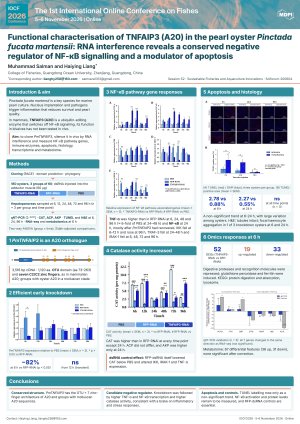
Introduction. The pearl oyster Pinctada fucata martensii underpins a high-value marine-pearl industry increasingly threatened by mass mortalities, yet the negative regulators that restrain its innate immune signalling remain almost unknown. In mammals, TNFAIP3 (A20) is the prototypical ubiquitin-editing brake on NF-κB, but its role in molluscs has never been tested. We report, to our knowledge, the first functional characterisation of TNFAIP3 in a pearl oyster.
Methods. We cloned PmTNFAIP3 and resolved its domain architecture, and then silenced it in vivo with gene-specific double-stranded RNA. Over a 96 h time course, we profiled canonical NF-κB-pathway genes (TNF-α, NF-κB, IKK, TRAF-3, IRAK-1) in the hepatopancreas by qRT-PCR, measured innate immune enzymes (CAT, ACP, AKP), and assessed apoptosis by TUNEL, against RFP-dsRNA and PBS controls.
Results. PmTNFAIP3 encodes a 1,120-amino-acid A20 orthologue with an N-terminal OTU deubiquitinase domain and seven C2/C2 zinc fingers. Silencing was maximal at 6 h with de-repressed NF-κB signalling: TNF-α rose to 6.1-fold and NF-κB (4.2-fold) and IKK increased (24–48 h), whereas the upstream adaptors TRAF-3 and IRAK-1 decreased (TRAF-3 to 0.18-fold), consistent with compensatory feedback. Catalase and acid phosphatase activities increased while alkaline phosphatase was unchanged, and TUNEL revealed elevated hepatopancreatic apoptosis, peaking at 6–24 h.
Conclusions. TNFAIP3 functions as a negative regulator of NF-κB and a modulator of apoptosis in P. fucata martensii, indicating that the A20 NF-κB negative-feedback axis is conserved in molluscs. These findings provide a mechanistic basis for managing immune balance and health in cultured pearl oysters.
Keywords
Keywords: Pinctada fucata martensii
TNFAIP3 (A20)
RNA interference
NF-κB signalling
innate immunity
apoptosis
Poster
IOCF2026_Sciforum-200604_Poster ..pdf
ASSESSMENT OF THE SUSTAINABILITY OF YELLOWFIN TUNA FISHERIES IN WEST SULAWESI BASED ON MULTI-DISTRICT PRODUCTION DATA
Use of Atlantic bluefin tuna (Thunnus thynnus) by-products in aquafeeds: trials with Dicentrarchus labrax and Litopenaeus vannamei