Event submissions
Published
This submission belongs to the session S2. Sustainable Fisheries and Aquaculture Innovations: Combating Overfishing and Advancing Aquatic Health of the event The 1st International Online Conference on Fishes
Published date
03 Nov, 2026
Academic Editor
 Wagner C. Valenti
Citation
Giovanni Marco Cusimano, Jui-Che Chiang, Killyan Monney, Karin Kurkjian, Petros Chronopoulos, Callum Howard, Eugenio Geremia, Gaetana Napolitano, Simona Paolacci, Use of Atlantic bluefin tuna (Thunnus thynnus) by-products in aquafeeds: trials with Dicentrarchus labrax and Litopenaeus vannamei, in Proceedings of The 1st International Online Conference on Fishes, 5 November–6 November 2026, MDPI: Basel, Switzerland
Share
Email
Facebook
Twitter
LinkedIn
Use of Atlantic bluefin tuna (Thunnus thynnus) by-products in aquafeeds: trials with Dicentrarchus labrax and Litopenaeus vannamei

Giovanni Marco Cusimano 1
Jui-Che Chiang 1
Killyan Monney 2
Karin Kurkjian 1
Petros Chronopoulos 3
Callum Howard 1

Eugenio Geremia 1,4

Gaetana Napolitano 5
Simona Paolacci 1
1. AquaBioTech Group, Central Complex, Naggar Street, Targa Gap, Mosta MST1761, Malta
2. AgroSup Dijon - Institut National Supérieur des Sciences Agronomiques, de l'Alimentation et de l'Environnement, rue des Champs Prévois, 21000 Dijon, France
3. Hellenic Centre for Marine Research (HCMR), Institute of Marine Biology, Biotechnology and Aquaculture (IMBBC), Anavyssos, Attika, Greece
4. Department of Science and Technology, Parthenope University of Naples, 80143 Naples, Italy
5. International PhD Programme, UNESCO Chair “Environment, Resources and Sustainable Development”, Department of Science and Technology, Parthenope University of Naples, 80143 Naples, Italy
Abstract
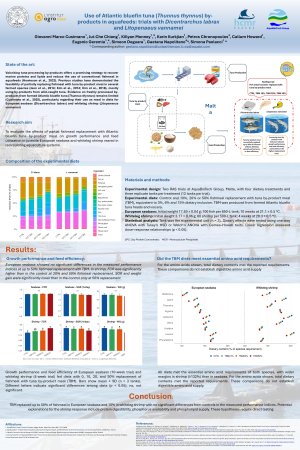
Global tuna catches reached a record 9.3 million tonnes in 2024, and processing generates by-products estimated at up to 55% of the fish biomass. This study tested whether meal from farmed Atlantic bluefin tuna (Thunnus thynnus) by-products (TBM), processed within 8 h of harvest, is equally suitable for two species with contrasting digestive physiology: the carnivorous European seabass (Dicentrarchus labrax) and the omnivorous whiteleg shrimp (Litopenaeus vannamei). For each species, four isonitrogenous, isolipidic diets replaced 0, 10, 20 and 50% of fishmeal with TBM. Each diet was tested in triplicate in recirculating systems: seabass (initial weight 17.50 g, 100 per tank, 10 weeks) and shrimp (3.15–3.18 g, 60 per tank, 4 weeks), fed to satiation four times daily; data were analysed by one-way ANOVA and Tukey HSD (p<0.05).
Seabass tolerated all inclusion levels: final body weights were 69.43±2.64, 69.36±3.33, 67.36±3.83 and 65.82±1.84 g and FCR 1.25±0.01, 1.25±0.01, 1.27±0.02 and 1.27±0.01 for the control, 10, 20 and 50% TBM diets. SGR (1.95–2.03% day⁻¹), PER (1.77–1.79), survival (>99%), condition factor K (1.29–1.34), viscera VSI (12.38–13.03% of body weight), liver HSI (2.35–2.55%) and whole-body protein CP (16.27–17.07%) and fat CF (14.13–15.10%) were unaffected.
Shrimp responded negatively: final body weight fell from 13.29±0.01 g to 12.70±0.45, 12.74±0.63 and 11.33±0.06 g, the lowest value differing significantly from all other diets. FCR rose from 0.87±0.02 to 0.94±0.04, 0.97±0.03 and 1.09±0.01 and PER declined from 2.65±0.06 to 2.49±0.12, 2.44±0.06 and 2.19±0.03, both differing significantly from the control at 20 and 50% TBM. SGR was significantly reduced only at 50% TBM, where feed intake was significantly higher than in the control, indicating impaired utilisation rather than reduced palatability; survival exceeded 94%. The same ingredient is therefore fully acceptable to a marine finfish yet limiting to a penaeid shrimp above 10% inclusion. This species-specific contrast has direct implications for by-product valorisation in Mediterranean aquaculture.
Keywords
Aquaculture
side-streams
European seabass
whiteleg shrimp
aquafeeds
Poster
PPT_Eugenio Geremia_MDPI_1.pdf
Functional characterisation of TNFAIP3 (A20) in the pearl oyster Pinctada fucata martensii: RNA interference reveals a conserved negative regulator of NF-κB signalling and a modulator of apoptosis.
Evaluating the Synergistic Impacts of Climate Change-Related Thermal Stress and Oxybenzone Contamination in Artemia salina Nauplii.