Event submissions
Published
This submission belongs to the session S1. Climate Change Impact and Marine Pollution of the event The 1st International Online Conference on Fishes
Published date
03 Nov, 2026
Academic Editor
 Pedro Morais
Citation
Carolina Andrea García Manes, Melissa I Ortiz, Félix R Román, Evaluating the Synergistic Impacts of Climate Change-Related Thermal Stress and Oxybenzone Contamination in Artemia salina Nauplii., in Proceedings of The 1st International Online Conference on Fishes, 5 November–6 November 2026, MDPI: Basel, Switzerland
Share
Email
Facebook
Twitter
LinkedIn
Evaluating the Synergistic Impacts of Climate Change-Related Thermal Stress and Oxybenzone Contamination in Artemia salina Nauplii.

Carolina Andrea García Manes 1
Melissa I Ortiz 1
Félix R Román 1
1. Department of Biology, University of Puerto Rico at Mayagüez, Mayagüez 00681, Puerto Rico
Abstract
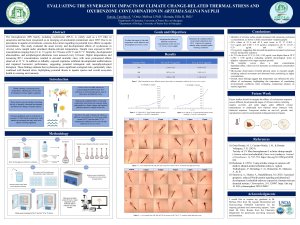
Oxybenzone (benzophenone-3, BP-3), a widely used ultraviolet filter in sunscreens, has emerged as an environmental contaminant of concern because of its persistence and potential toxicity in aquatic ecosystems. Rising ocean temperatures associated with climate change may further exacerbate the effects of chemical pollutants on marine organisms. This study investigated the combined effects of thermal stress and oxybenzone exposure on Artemia salina nauplii under simulated climate-relevant conditions. Nauplii were exposed to BP-3 concentrations ranging from 0.1 to 1.5 µg/mL for 72 hours at 27 °C and 32 °C, and mortality and morphological alterations were assessed every 24 hours.
Mortality increased in a concentration-dependent manner at both temperatures. Lower LC₅₀ values observed at 32 °C after 24 and 48 hours indicated enhanced toxicity under elevated temperature conditions. Microscopic observations revealed reduced locomotor activity and abnormal body positioning in exposed nauplii, suggesting physiological stress. Overall, the results demonstrate that thermal stress can modulate the toxic effects of oxybenzone, highlighting the complex interactions between climate change and chemical pollution in aquatic environments. These findings highlight the importance of considering climate change-related stressors when evaluating contaminant impacts on marine organisms and underscore potential risks to aquatic ecosystem health in warming environments. Understanding these interactions is essential for improving ecological risk assessments and predicting the consequences of multiple environmental stressors on aquatic species in the context of global climate change.
Keywords
Oxybenzone
Artemia salina
Thermal Stress
Climate Change
Marine Pollution
Ecotoxicology
Aquatic Toxicology
Poster
Poster Paper- Carolina 2.pdf
Use of Atlantic bluefin tuna (Thunnus thynnus) by-products in aquafeeds: trials with Dicentrarchus labrax and Litopenaeus vannamei
Influence of different feed restriction regimes on compensatory response and individual variability in juvenile Brycon amazonicus