Event submissions
Published
This submission belongs to the session S2. Sustainable Fisheries and Aquaculture Innovations: Combating Overfishing and Advancing Aquatic Health of the event The 1st International Online Conference on Fishes
Published date
03 Nov, 2026
Academic Editor
 Wagner C. Valenti
Citation
Isabella Alves Brunetti, Fabiana Pilarski, Roberta de Almeida Stramasso, Rafaella Caroline Pereira, Gabriela Rodrigues Celestino, Maria Luzia Napolitano Pires, Emilly Cristine Paulino dos Santos, Claudinei da Cruz, Acute toxicity and histopathological liver changes induced by tylosin base in colored carp (Cyprinus carpio), in Proceedings of The 1st International Online Conference on Fishes, 5 November–6 November 2026, MDPI: Basel, Switzerland
Share
Email
Facebook
Twitter
LinkedIn
Acute toxicity and histopathological liver changes induced by tylosin base in colored carp (Cyprinus carpio)

Isabella Alves Brunetti 1
Fabiana Pilarski 1
Roberta de Almeida Stramasso 2
Rafaella Caroline Pereira 2
Gabriela Rodrigues Celestino 2
Maria Luzia Napolitano Pires 2
Emilly Cristine Paulino dos Santos 2
Claudinei da Cruz 2
1. Caunesp, Unesp, Jaboticabal - SP, 14884-900, Brazil
2. LEEA, Unifeb, Barretos - SP, 14783-226, Brazil
Abstract
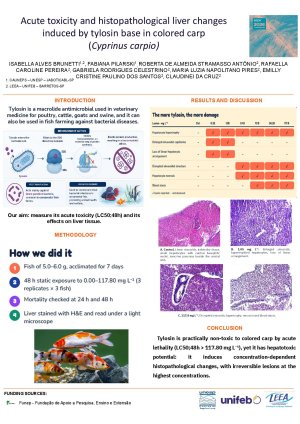
Tylosin is a macrolide antimicrobial used in veterinary medicine for the treatment and control of bacterial infections in poultry, cattle, goats, and swine. Furthermore, this drug can also be used in fish farming to control bacterial diseases in fish. Thus, the objective of this study was to evaluate the acute toxicity (LC50;48h) and histopathological effects of tylosin on liver tissue. Fish weighing between 5.0 and 6.0 g were acclimated in a bioassay under controlled conditions for seven days and subsequently exposed to base tylosin concentrations (0.00 to 117.80 mg L⁻¹) in a static system for 48 hours, with three replicates and three fish per replicate. Mortalities were recorded after 24 and 48 hours of exposure. At the end of the trial, liver samples were collected, processed for histological analysis, stained with hematoxylin-eosin, and evaluated under a light microscope. For acute toxicity, the lethal concentration of 50% of tylosin base was > 117.80 mg L-1 for the colored carp, considered practically non-toxic. No fish mortality occurred during the experimental period. In the histopathological analysis, in the control, the liver has a linear arrangement of sinusoidal capillaries, with a trabecular appearance to the tissue. The hepatocytes are small and numerous, with central basophilic nuclei, acidophilic cytoplasm, and the presence of the exocrine pancreas alongside the central vein. At 0.32 and 1.05 mg L-1, there was an increase in the volume of the sinusoidal capillary, hypertrophy of the hepatocytes, and disruption of the linear structure of the hepatocytes. At 3.43 mg L-1, disruption of sinusoidal capillary structures, hypertrophy, and areas of hepatocyte necrosis occurred. At 11.15, 36.25, and 117.8 mg L-1, disruption of sinusoidal capillary structures, hypertrophy, areas of necrosis, and blood stasis occurred. Tylosin exhibits hepatotoxic potential for colored carp, inducing concentration-dependent histopathological changes, with irreversible lesions observed at the highest concentrations.
Keywords
Antibiotics
ornamental fish farming
ecotoxicity
histology
Poster
Poster_Isabella_Tylosina.pdf
Anesthetic responses of the neotropical catfish pacamã (Lophiosilurus alexandri) to the essential oil of Lippia alba
Synergistic Effects of Biofloc and Aquaponics on Catfish Growth and Jute Biomass