Event submissions
Published
This submission belongs to the session S1. Climate Change Impact and Marine Pollution of the event The 1st International Online Conference on Fishes
Published date
03 Nov, 2026
Academic Editor
 Pedro Morais
Citation
Rosicleire Veríssimo-Silveira, Amanda Satomi Tatibana, Beatriz Santos Lopes, Cristieli Souza Fernanda Belancieri Souza, Alexandre Ninhaus-Silveira, Elevated Temperature Accelerates Ovarian Maturation without Somatic Costs in Astyanax lacustris (Characiformes, Characidae), in Proceedings of The 1st International Online Conference on Fishes, 5 November–6 November 2026, MDPI: Basel, Switzerland
Share
Email
Facebook
Twitter
LinkedIn
Elevated Temperature Accelerates Ovarian Maturation without Somatic Costs in Astyanax lacustris (Characiformes, Characidae)

Rosicleire Veríssimo-Silveira 1
Amanda Satomi Tatibana 1
Beatriz Santos Lopes 1
Cristieli Souza Fernanda Belancieri Souza 1
Alexandre Ninhaus-Silveira 1
1. Neotropical Ichthyology Laboratory (LINEO), School of Engineering, São Paulo State University “Júlio de Mesquita Filho” (UNESP), Ilha Solteira Campus, São Paulo, Brazil.
Abstract
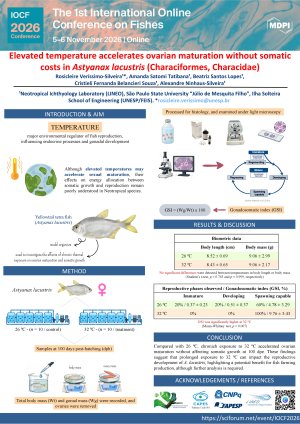
Introduction: Temperature is a major environmental regulator of fish reproduction, influencing endocrine processes and gonadal development. Although elevated temperatures may accelerate sexual maturation, their effects on energy allocation between somatic growth and reproduction remain poorly understood in Neotropical species. Astyanax lacustris, a commercially and ecologically relevant Neotropical characid, was used as a model to investigate the effects of chronic thermal exposure on ovarian maturation and somatic growth. Methods: Female Astyanax lacustris reared from the juvenile stage at 26 °C (n = 10, control) and 32 °C (n = 10, treatment) were sampled at 100 days post-hatching (dph). Total body mass (Wt) and gonad mass (Wg) were recorded, and ovaries were removed, processed for histology, and examined under light microscopy. The gonadosomatic index (GSI) was calculated as GSI = (Wg/Wt) x 100. Results: At 26 °C, females exhibited a mean body length of 8.52 ± 0.69 cm and body mass of 9.06 ± 2.99 g, distributed across the Immature (20%; GSI = 0.37 ± 0.23%), Developing (20%; GSI = 0.51 ± 0.37%), and Spawning capable (60%; GSI = 4.78 ± 3.29%) phases. At 32 °C, all females were classified as Spawning capable (100%), with a mean body length of 8.43 ± 0.65 cm, body mass of 9.06 ± 2.17 g, and GSI of 9.76 ± 5.43%. No significant differences were detected between temperatures in body length or body mass (Student’s t-test, p = 0.763 and p = 0.999, respectively), whereas GSI was significantly higher at 32 °C (Mann–Whitney test, p = 0.007). Conclusion: Compared to 26 ºC, chronic exposure to 32 ºC accelerated ovarian maturation without affecting somatic growth at 100 dph. These findings suggest that prolonged exposure to 32 ºC can impact the reproductive development of A. lacustris, highlighting a potential benefit for fish farming production, although further analysis is required to verify the viability of the oocytes and offspring.
Keywords
Gonadosomatic index
Neotropical fish
Ovarian maturation
Water temperature
Poster
Pôster IOCF 2026 - Rosicleire Verissimo.pdf
Synergistic Effects of Biofloc and Aquaponics on Catfish Growth and Jute Biomass
Stocking density and dietary nanoplastic inclusion modify the digestive functionality in juvenile gilthead seabream (Sparus aurata)