Event submissions
Published
This submission belongs to the session S2. Sustainable Fisheries and Aquaculture Innovations: Combating Overfishing and Advancing Aquatic Health of the event The 1st International Online Conference on Fishes
Published date
03 Nov, 2026
Academic Editor
 Wagner C. Valenti
Citation
Sara Palenque, Isabel del Carmen Ruiz-Rodríguez, Alba Galafat, Mercedes Carrillo-García, Alejandro Morcillo-Guillén, Antonio Jesús Vizcaíno, José María García-Luque, Juan Miguel Mancera, Francisco Javier Alarcón-López, Stocking density and dietary nanoplastic inclusion modify the digestive functionality in juvenile gilthead seabream (Sparus aurata), in Proceedings of The 1st International Online Conference on Fishes, 5 November–6 November 2026, MDPI: Basel, Switzerland
Share
Email
Facebook
Twitter
LinkedIn
Stocking density and dietary nanoplastic inclusion modify the digestive functionality in juvenile gilthead seabream (Sparus aurata)

Sara Palenque 1
Isabel del Carmen Ruiz-Rodríguez 1
Alba Galafat 1
Mercedes Carrillo-García 2
Alejandro Morcillo-Guillén 1
Antonio Jesús Vizcaíno 1
José María García-Luque 2

Juan Miguel Mancera 2

Francisco Javier Alarcón-López 1
1. Dept. Biology and Geology, University of Almería, 04120 Almería, Spain
2. Dept. Biology, Faculty of Marine and Environmental Sciences, Instituto Universitario de Investigación Marina (INMAR), Campus de Excelencia Internacional del Mar (CEI·MAR), University of Cádiz, 11510 Puerto Real, Cádiz, Spain
Abstract
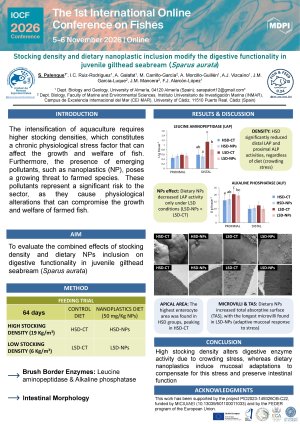
Aquaculture has faced several challenges associated with the need to increase fish production (which forces an increase in farming density), as well as the presence of marine contaminants such as nanoplastics (NPs). These pollutants pose a significant risk to the sector by inducing physiological alterations that can compromise the growth and welfare of cultivated fish. Therefore, the aim of this study was to evaluate the combined effects of stocking density and dietary NP inclusion on digestive functionality in juvenile gilthead seabream (Sparus aurata). To this end, a control diet (CT) was formulated, alongside a second diet containing the same ingredients but supplemented with 5% NPs (spherical polystyrene nanoparticles, 50 nm diameter; Bang Laboratories). Both diets were administered to juveniles reared under either low-stocking-density (LSD) or high-stocking-density (HSD) conditions for 64 days. The results revealed higher activities of leucine aminopeptidase and alkaline phosphatase in the LSD-CT treatment, whereas enzyme activities were reduced at HSD regardless of dietary treatment. Conversely, enterocyte apical area was greatest in the HSD-CT group, followed by the HSD-NP group. However, microvillus height and total absorptive surface area were higher in juveniles fed the NP-supplemented diet. Collectively, dietary nanoplastic inclusion decreased intestinal enzyme activity under low-density conditions and induced adaptive ultrastructural changes to maintain digestive functionality, highlighting the need to evaluate additional parameters to fully understand the combined effects of both stressors on fish health.
Keywords
Gilthead seabream
Nanoplastics
Stocking density
Digestive functionality
Intestinal ultrastructure
Poster
Poster_Sciforum-195112_Sara_Palenque.pdf
Elevated Temperature Accelerates Ovarian Maturation without Somatic Costs in Astyanax lacustris (Characiformes, Characidae)
Distribution of microplastics in water, sediment and fish from the Krka River