Event submissions
Published
This submission belongs to the session S1. Climate Change Impact and Marine Pollution of the event The 1st International Online Conference on Fishes
Published date
03 Nov, 2026
Academic Editor
 Pedro Morais
Citation
Martina Ugrinović, Davor Merkaš, Damir Valić, Kristina Pikelj, Sara Šariri, Vlatka Filipović Marijić, Distribution of microplastics in water, sediment and fish from the Krka River, in Proceedings of The 1st International Online Conference on Fishes, 5 November–6 November 2026, MDPI: Basel, Switzerland
Share
Email
Facebook
Twitter
LinkedIn
Distribution of microplastics in water, sediment and fish from the Krka River

Martina Ugrinović 1
Davor Merkaš 1
Damir Valić 1
Kristina Pikelj 2
Sara Šariri 1

Vlatka Filipović Marijić 1
1. Division for Marine and Environmental Research
Laboratory for the biological effects of metals
Ruđer Bošković Institute, Bijenička cesta 54, 10000 Zagreb, Croatia
2. Department of Geology, University of Zagreb Faculty of Science, Zagreb, Croatia
Abstract
Aquatic ecosystems are exposed to a range of contaminants originating from urban, industrial and agricultural activities. Among them, microplastics (MPs) have emerged as one of the most widespread pollutants due to their persistence, input into aquatic systems and occurrence across water, sediment and biota. Detection and characterization of MPs remain challenging because of their small size, diverse composition and the complexity of environmental and biological samples.
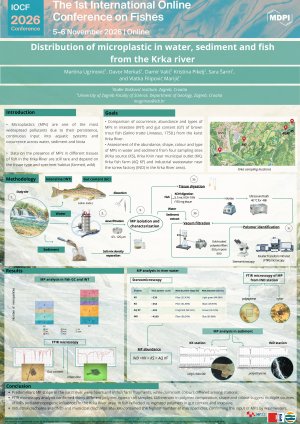
This study investigated the occurrence of MPs in water, sediment and fish from four locations along the watercourse of the Krka River, representing a gradient of anthropogenic influence from the river source to aquaculture, urban and industrial areas. Water samples were filtered through sieves of decreasing mesh size (1 mm, 500 μm, 125 μm and 63 μm), while sediment was collected using a grab sampler and processed by density separation using NaCl solution. Fish brown trout (Salmo trutta) were collected by electrofishing and from aquaculture facilities. Fish intestine and gills were chemically digested, followed by vacuum filtration through gold-coated polyester filters with a pore size of 0.8 μm. Potential MP particles were initially identified by stereomicroscopy, while polymer composition was confirmed using FT-IR microscopy. Preliminary results confirmed the presence of MPs in all investigated matrices. Fibres and films of different colours were detected in water samples, including those collected near the Krka spring, indicating MP contamination even in areas considered pristine. In sediment, higher abundance of MPs was found in industrial wastewater location, mostly defined as polyethylene. In fish, MPs were detected in digestive tract and gills, suggesting uptake from the surrounding environment. Generally, several polymer types, including polyethylene, polypropylene, nylon, ethylene-vinyl acetate and polybutylene terephthalate, were identified in water, sediment and fish tissues.
These findings highlight the widespread occurrence of MPs in the Krka River and the need for continuous monitoring of freshwater ecosystems.
Keywords
microplastics
freshwater ecosystem
brown trout
microscopy
FT-IR
Poster
Distribution of microplastic in water, sediment and fish from the Krka river_Ugrinović_Martina.pdf
Stocking density and dietary nanoplastic inclusion modify the digestive functionality in juvenile gilthead seabream (Sparus aurata)
Design of upgrading strategies for the resilience of fishing communities in the Tres Palos lagoon, Acapulco, Mexico