Event submissions
Published
This submission belongs to the session S2. Sustainable Fisheries and Aquaculture Innovations: Combating Overfishing and Advancing Aquatic Health of the event The 1st International Online Conference on Fishes
Published date
03 Nov, 2026
Academic Editor
 Wagner C. Valenti
Citation
Kevin Luigi Azevedo de Vasconcelos, Camila Maria Barbosa Pereira, Maria Eduarda Soares da Silva, Maria Alzirene de Souza Ferreira, Amanda Queiroz Azevedo, Elideth Pacheco Monteiro, Weverton John Pinheiro dos Santos, Michele Velasco, José Ledamir Sindeaux Neto, Occurrence of Kudoa sp. (Myxozoa: Multivalvulida) in the skeletal musculature of Cichla sp. (Cichliformes: Cichlidae) from the Arapiranga River, Vila de Beja, Abaetetuba, Pará, Brazil, in Proceedings of The 1st International Online Conference on Fishes, 5 November–6 November 2026, MDPI: Basel, Switzerland
Share
Email
Facebook
Twitter
LinkedIn
Occurrence of Kudoa sp. (Myxozoa: Multivalvulida) in the skeletal musculature of Cichla sp. (Cichliformes: Cichlidae) from the Arapiranga River, Vila de Beja, Abaetetuba, Pará, Brazil

Kevin Luigi Azevedo de Vasconcelos 1
Camila Maria Barbosa Pereira 2
Maria Eduarda Soares da Silva 3
Maria Alzirene de Souza Ferreira 1
Amanda Queiroz Azevedo 1
Elideth Pacheco Monteiro 4
Weverton John Pinheiro dos Santos 5
Michele Velasco 3
José Ledamir Sindeaux Neto 1
1. Federal Rural University of the Amazon (UFRA), Postgraduate Program in Animal Reproduction in the Amazon (ReproAmazon), Belém, Pará, Brazil
2. Federal University of Pará (UFPA) - Postgraduate Program in Biodiversity and Biotechnology in the Legal Amazon (BIONORTE), Belém, Pará, Brazil
3. Federal Rural University of the Amazon (UFRA) - Postgraduate Program in Animal Health and Production in the Amazon (PPGSPAA), Belém, Pará, Brazil
4. Marine and Coastal Studies Group (GEMC), Federal University of Pará, Belém, Pará, Brazil
5. Federal University of Pará (UFPA) - Postgraduate Program in Aquatic Ecology and Fisheries, Belém, Pará, Brazil
Abstract
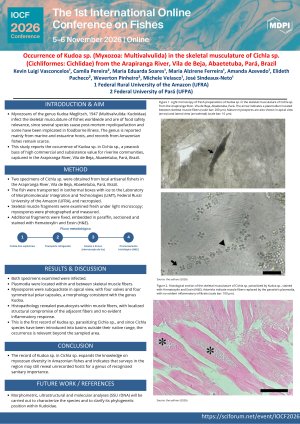
Myxozoans of the genus Kudoa Meglitsch, 1947 (Multivalvulida: Kudoidae) infect the skeletal musculature of fishes worldwide and are of food safety relevance, since several species cause post-mortem myoliquefaction and some have been implicated in foodborne illness. The genus is reported mainly from marine and estuarine hosts, and records from Amazonian fishes remain scarce. This study reports Kudoa sp. in Cichla sp., a peacock bass of high commercial and subsistence value for riverine communities, captured in the Arapiranga River, Beja Island, Abaetetuba, Pará, Brazil. Two specimens obtained from local artisanal fishers were transported in insulated boxes with ice to the Morphomolecular Integration and Technologies Laboratory (LIMT), Federal Rural University of the Amazon (UFRA), and necropsied. Skeletal muscle fragments were examined fresh under light microscopy, and myxospores were photographed and measured; additional fragments were fixed, embedded in paraffin, sectioned, and stained with hematoxylin and eosin. Both specimens were infected. Plasmodia were located within and between skeletal muscle fibers. Myxospores were subquadrate in apical view, with four valves and four symmetrical polar capsules, a morphology consistent with the genus Kudoa. Histopathology revealed pseudocysts within muscle fibers, with localized structural compromise of the adjacent fibers and no evident inflammatory response. This is the first record of Kudoa sp. parasitizing Cichla sp. Because Cichla species have been introduced into basins outside their native range, this occurrence is relevant beyond the sampled area and indicates that surveys of myxozoans in Amazonian fishes may still reveal unrecorded hosts for a genus of recognized sanitary importance.
Keywords
ichthyoparasitology
myxozoans
peacock bass
Amazon
Poster
kevin.pdf
Production–profitability trade-offs in amazonian round fish farming: the role of production system and genetic group
MICROPLASTIC CONTAMINATION IN EDIBLE BOGUE (BOOPS BOOPS, SPARIDAE) MUSCLE: PRELIMINARY CONSUMER EXPOSURE ASSESSMENT