Event submissions
Published
This submission belongs to the session S1. Climate Change Impact and Marine Pollution of the event The 1st International Online Conference on Fishes
Published date
03 Nov, 2026
Academic Editor
 Pedro Morais
Citation
Stylianos Neonakis, Eirini Paraskeva, Stefania Doulgeraki, Lambros Kokokiris, MICROPLASTIC CONTAMINATION IN EDIBLE BOGUE (BOOPS BOOPS, SPARIDAE) MUSCLE: PRELIMINARY CONSUMER EXPOSURE ASSESSMENT, in Proceedings of The 1st International Online Conference on Fishes, 5 November–6 November 2026, MDPI: Basel, Switzerland
Share
Email
Facebook
Twitter
LinkedIn
MICROPLASTIC CONTAMINATION IN EDIBLE BOGUE (BOOPS BOOPS, SPARIDAE) MUSCLE: PRELIMINARY CONSUMER EXPOSURE ASSESSMENT

Stylianos Neonakis 1
Eirini Paraskeva 2
Stefania Doulgeraki 1

Lambros Kokokiris 1
1. Department of Nutritional Sciences and Dietetics, School of Health Sciences, International Hellenic University, Alexander University Campus, Sindos, 57400 Thessaloniki, Greece
2. Department of Educational and Social Policy, School of Social Sciences, Humanities and Arts, University of Macedonia, 54636 Thessaloniki, Greece
Abstract
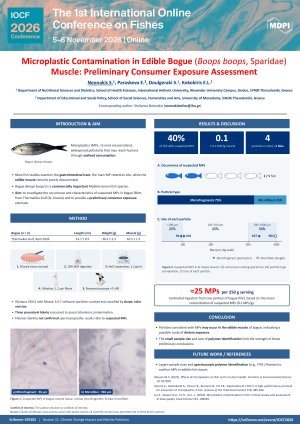
Microplastic pollution is an increasing concern in marine ecosystems, with growing attention placed on the potential transfer of microplastics (MPs) to humans through seafood consumption. While most studies have focused on the gastrointestinal tract of fish, the occurrence of MPs in edible muscle tissue remains insufficiently documented. This preliminary study investigated the occurrence and characteristics of particles suspected to be MPs in the fillets of bogue (Boops boops), a commercially important Mediterranean fish species.
Five bogue specimens were collected from the Thermaikos Gulf, Northern Greece. Edible muscle tissue was excised and chemically digested using 10% KOH solution, followed by density separation with saturated NaCl solution (1.2 g/mL). The recovered material was filtered through 1.2 μm nitrocellulose membranes and visually examined under an Olympus SZX12 stereomicroscope (×7.0-×90.0) using Mosaic 3.0.7 software. Suspected MPs were counted and classified by shape and color, and particle size was recorded. Three procedural blanks were processed to assess laboratory contamination. Polymer identity was not confirmed by spectroscopic techniques.
Suspected MPs were detected in 40% of the analyzed samples, with a median abundance of 0.1 MPs/g of muscle tissue. Microfragments accounted for 75% of the detected particles and microfibers for 25%; all particles were blue. Microfragment perimeter ranged from 96 to 103 μm, whereas microfiber length ranged from 500 to 1000 μm.
These preliminary findings suggest that particles consistent with MPs may occur in the edible muscle tissue of bogue, indicating a possible route of dietary exposure. However, the small sample size and lack of polymer identification limit the strength of the conclusions. Larger studies using spectroscopic techniques are required to confirm the occurrence of MPs in edible fish tissues.
Keywords
Microplastics
Boops boops
bogue
seafood safety
Poster
Neonakis_IOCF2026.pdf
Occurrence of Kudoa sp. (Myxozoa: Multivalvulida) in the skeletal musculature of Cichla sp. (Cichliformes: Cichlidae) from the Arapiranga River, Vila de Beja, Abaetetuba, Pará, Brazil
Intestinal Histomorphometric Responses of Yellowtail Lambari (Astyanax bimaculatus) Fed Diets Containing Tenebrio molitor Larval Meal