Event submissions
Published
This submission belongs to the session S2. Sustainable Fisheries and Aquaculture Innovations: Combating Overfishing and Advancing Aquatic Health of the event The 1st International Online Conference on Fishes
Published date
03 Nov, 2026
Academic Editor
 Wagner C. Valenti
Citation
Akuita Fernanda Caetana Lima, Sirlene Souza Rodrigues Sartori, Fernanda Carlini Cunha dos Santos, Mariane da Silva Ferreira Magalhães, Thiago Vasconcelos Melo, Guilherme de Souza Moura, Intestinal Histomorphometric Responses of Yellowtail Lambari (Astyanax bimaculatus) Fed Diets Containing Tenebrio molitor Larval Meal, in Proceedings of The 1st International Online Conference on Fishes, 5 November–6 November 2026, MDPI: Basel, Switzerland
Share
Email
Facebook
Twitter
LinkedIn
Intestinal Histomorphometric Responses of Yellowtail Lambari (Astyanax bimaculatus) Fed Diets Containing Tenebrio molitor Larval Meal

Akuita Fernanda Caetana Lima 1
Sirlene Souza Rodrigues Sartori 2
Fernanda Carlini Cunha dos Santos 1
Mariane da Silva Ferreira Magalhães 1
Thiago Vasconcelos Melo 1

Guilherme de Souza Moura 3
1. Instituto de Ciências Agrárias, Federal University of Jequitinhonha and Mucuri Valleys (UFVJM), Unaí, Minas Gerais, Brazil
2. Federal University of Viçosa – Animal Biology Department, Viçosa, Minas Gerais, Brazil
3. Departamento de Zootecnia, Federal University of Jequitinhonha and Mucuri Valleys (UFVJM), Unaí, Minas Gerais, Brazil
Abstract
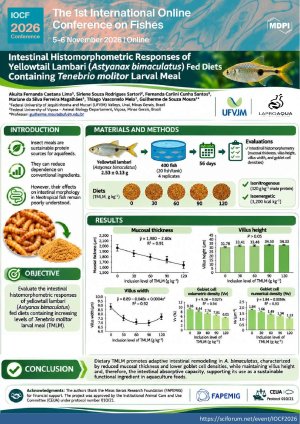
The use of insect meals in aquafeeds has emerged as a sustainable strategy to reduce dependence on conventional protein sources. However, the effects of these ingredients on intestinal morphology remain poorly understood in Neotropical fish species. This study evaluated the intestinal histomorphometric responses of yellowtail lambari (Astyanax bimaculatus) fed diets containing increasing levels of Tenebrio molitor larval meal (TMLM). A total of 400 fish (2.53 ± 0.13 g) were distributed in a completely randomized design with five dietary treatments (0, 30, 60, 90, and 120 g kg⁻¹ TMLM) and four replicates for 56 days. Diets were formulated to be isonitrogenous (320 g kg⁻¹ crude protein) and isoenergetic (3,200 kcal kg⁻¹). Intestinal samples were processed using standard histological techniques, and morphometric analyses included mucosal thickness, villus height, villus width, and goblet cell volumetric and numerical densities. Data were subjected to one-way ANOVA and regression analysis at a significance level of P < 0.05. Dietary TMLM significantly affected most intestinal histomorphometric variables (P < 0.05). Mucosal thickness decreased linearly from 1,980 to 1,668 µm as TMLM inclusion increased. Villus height was not affected by dietary treatments (P > 0.05), remaining between 31.78 and 34.50 µm. Villus width showed a significant quadratic response, with lower values observed at intermediate and high inclusion levels. Goblet cell volumetric density decreased from 9.26 to 6.01%, while numerical density declined from 1.84 to 1.13 µm⁻³ with increasing TMLM inclusion. The maintenance of villus height, associated with reduced mucosal thickness and lower goblet cell densities, suggests adaptive intestinal remodeling without impairment of absorptive capacity. These findings indicate that TMLM promotes beneficial morphofunctional adjustments in the intestine of A. bimaculatus and supports its use as a sustainable functional ingredient in aquaculture feeds.
Acknowledgments: The authors thank the Minas Gerais Research Foundation (FAPEMIG) for financial support. The project was approved by the Institutional Animal Care and Use Committee (CEUA) under protocol number 010/21.
Keywords
aquaculture nutrition
fish physiology
insect meal
sustainable feed
Poster
Poster Histo.pdf
MICROPLASTIC CONTAMINATION IN EDIBLE BOGUE (BOOPS BOOPS, SPARIDAE) MUSCLE: PRELIMINARY CONSUMER EXPOSURE ASSESSMENT
Intestinal antioxidant status and digestive activity in gilthead sea bream (Sparus aurata) subjected to moderate sustained swimming and fed a cysteamine-supplemented diet