Event submissions
Published
This submission belongs to the session S2. Sustainable Fisheries and Aquaculture Innovations: Combating Overfishing and Advancing Aquatic Health of the event The 1st International Online Conference on Fishes
Published date
03 Nov, 2026
Academic Editor
 Maria Angeles Esteban
Citation
Eugenio Geremia, Gianluca Fasciolo, Adriana Petito, Marco Pacileo, Alessandra La Pietra, Sara Esposito Marroccella, Paola Venditti, Claudio Agnisola, Ida Ferrandino, Gaetana Napolitano, Brewer's spent grain and brewer's spent yeast as partial fishmeal replacers in juvenile goldfish (Carassius auratus): tissue-specific redox responses and intestinal histomorphology, in Proceedings of The 1st International Online Conference on Fishes, 5 November–6 November 2026, MDPI: Basel, Switzerland
Share
Email
Facebook
Twitter
LinkedIn
Brewer's spent grain and brewer's spent yeast as partial fishmeal replacers in juvenile goldfish (Carassius auratus): tissue-specific redox responses and intestinal histomorphology

Eugenio Geremia 1,2

Gianluca Fasciolo 3

Adriana Petito 3
Marco Pacileo 3
Alessandra La Pietra 3
Sara Esposito Marroccella 4

Paola Venditti 3
Claudio Agnisola 3

Ida Ferrandino 3

Gaetana Napolitano 4
1. Department of Science and Technology, Parthenope University of Naples, 80143 Naples, Italy
2. AquaBioTech Group, Central Complex, Naggar Street, Targa Gap, Mosta MST1761, Malta
3. Department of Biology, University of Naples Federico II, Naples, Italy
4. International PhD Programme, UNESCO Chair “Environment, Resources and Sustainable Development”, Department of Science and Technology, Parthenope University of Naples, 80143 Naples, Italy
Abstract
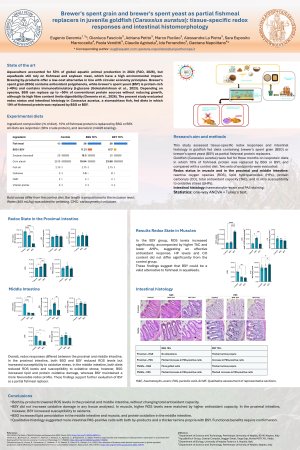
Reducing fishmeal inclusion is a major objective for improving aquaculture sustainability. Alternative protein sources derived from industrial by-products may support fish growth while maintaining health and welfare. This study evaluated the effects of partially replacing fishmeal with brewer's spent grain (BSG) or brewer's spent yeast (BSY) in juvenile goldfish (Carassius auratus L.) diets. Three isonitrogenous diets were tested: a control diet and two experimental diets in which 10% of fishmeal protein was replaced by either BSG or BSY. Growth performance, proximal gut histomorphology, and tissue redox status were assessed. Intestinal sections were stained with hematoxylin–eosin and periodic acid–Schiff to evaluate morphology and glycan-containing cells. Redox status was determined by measuring reactive oxygen species (ROS), hydroperoxides (HPs), protein carbonyls (COs), susceptibility to oxidative stress, and total antioxidant capacity (TAC). Neither BSG nor BSY affected body weight or total length, indicating that both ingredients can partially replace fishmeal without impairing growth. Redox responses were tissue-specific. In muscle, BSG increased HPs and susceptibility to oxidative stress, whereas BSY increased ROS but enhanced TAC and reduced oxidative damage, suggesting activation of antioxidant defenses. In the proximal gut, both diets reduced ROS but increased susceptibility to oxidative stress. Histological analysis showed preserved intestinal morphology in the control and BSG groups, while BSY increased lamina propria thickness. Both supplemented diets increased PAS-positive cells, particularly BSG, suggesting a local inflammatory response. In the mid-intestine, both diets reduced ROS production and susceptibility to oxidative stress. However, BSG increased HP and CO levels, indicating oxidative damage, whereas BSY maintained a more balanced redox status. Overall, both BSG and BSY supported fish growth and represent promising ingredients for circular aquafeeds. Nevertheless, BSY exhibited a more favorable redox profile across tissues, highlighting its potential as a valuable alternative protein source for sustainable aquaculture.
Keywords
BSG
BSY
fish nutrition
sustainable aquafeed
oxidative stress.
Poster
PPT_Eugenio Geremia_MDPI_2.pdf
Effects of stocking density on growth performance of Piaractus brachypomus reared in recirculating aquaculture system (RAS)
The development of a biorefinery strategy for the valorization of Ulva biomass