Event submissions
Published
This submission belongs to the session S2. Sustainable Fisheries and Aquaculture Innovations: Combating Overfishing and Advancing Aquatic Health of the event The 1st International Online Conference on Fishes
Published date
03 Nov, 2026
Academic Editor
 Maria Angeles Esteban
Citation
Germán López, Alejandro Antonio Morcillo Guillen, Isabel del Carmen Ruiz Rodríguez, Alba Galafat, Luis Hidalgo Oller, Jorge Herrera González, Mariola Querol, Jessica Brol, Silvia Martínez Llorens, David Sánchez Peñaranda, Francisco Javier Alarcón López, Antonio Jesús Vizcaino, Effect of Inclusion of Tenebrio molitor and Aquaculture By-products on the Physico-chemical Properties of Whiteleg Shrimp (Penaeus vannamei) Aquafeeds, in Proceedings of The 1st International Online Conference on Fishes, 5 November–6 November 2026, MDPI: Basel, Switzerland
Share
Email
Facebook
Twitter
LinkedIn
Effect of Inclusion of Tenebrio molitor and Aquaculture By-products on the Physico-chemical Properties of Whiteleg Shrimp (Penaeus vannamei) Aquafeeds

Germán López 1
Alejandro Antonio Morcillo Guillen 1
Isabel del Carmen Ruiz Rodríguez 1
Alba Galafat 1
Luis Hidalgo Oller 1
Jorge Herrera González 2
Mariola Querol 3
Jessica Brol 3

Silvia Martínez Llorens 3
David Sánchez Peñaranda 3

Francisco Javier Alarcón López 1
Antonio Jesús Vizcaino 1
1. Lab. 0.24. Dpto. Biología y Geología. Escuela Superior de Ingeniería, Universidad de Almería. La Cañada de San Urbano, 04120 Almería, Spain
2. LifeBioencapsulation S.L., Parque Científico PITA, 04131 El Alquián, Almería, Spain
3. Dpto. Ciencia Animal, Universidad Politécnica de Valencia, 04022 Valencia, Spain
Abstract
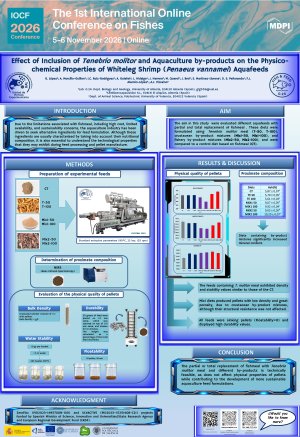
Due to the limitations associated with fishmeal, including high cost, limited availability, and sustainability concerns, the aquaculture industry has been driven to seek alternative ingredients for feed formulation. Although these ingredients are usually characterised by taking into account their nutritional composition, it is also essential to understand the technological properties that they may exhibit during feed processing and pellet manufacture. In this study, different aquafeeds with partial and total replacement of fishmeal were evaluated. These diets were formulated using Tenebrio molitor meal (T-50 and T-100), crustacean by-product mixtures (Mix1-50 and Mix1-100), and fishery by-product mixtures (Mix2-50 and Mix2-100), and were compared to a control diet based on fishmeal (CT). Both the proximate composition (protein, lipid, ash, and moisture content) and several physical properties of the pellets were analysed, including bulk density, water stability, floatability, and durability. The results show that diets containing by-product mixtures significantly increased mineral content, as reflected by a higher ash level that exceeded 9%. Regarding the physical properties, the feeds containing T. molitor meal exhibited density and stability values similar to those of the CT, approximately 670 g/L and 82% stability. In contrast, the Mix1 diets produced pellets with low density (less than 660 g/L) and high porosity, although their structural resistance was not affected. Furthermore, all feeds were sinking pellets and displayed high durability values above 99%. In conclusion, the partial or total replacement of fishmeal with Tenebrio molitor meal and different by-products is technically feasible, as it does not affect the physical properties of pellets while still contributing to the development of more sustainable aquaculture feed formulations.
Keywords
aquafeeds
aquaculture by-products
physical properties
Poster
Sciforum-195259-GLG.pdf
Breeding Performance, Physiological Responses, and Salinity Tolerance of Swordtail (Xiphophorus hellerii) in Inland Saline Water
Molecular Identification of Charru mussel from Ennore Creek, Southern India, Using COI DNA Barcoding